Project Navya Takes Early Strides Towards Sustainable Livelihoods
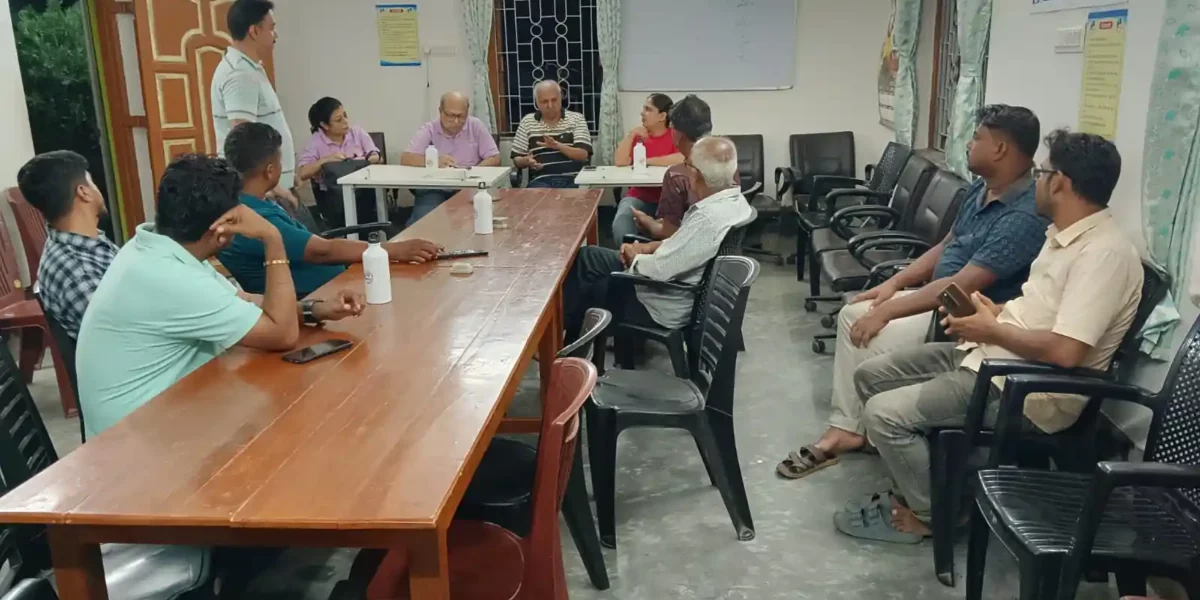
A two-day monitoring and review visit to Project Navya was conducted by representatives of Unity Small Finance Bank on 2nd and 3rd June 2026. Supported by Unity Small Finance Bank and implemented by Mukti, Project Navya seeks to create sustainable livelihood opportunities for women in the Sundarbans through skill development, weaving-based enterprise creation, and community-led production systems.
The visiting team comprised Mr. Ravi Shankar Sarkar, Ms. Archana Goyal, and Ms. Amrita Basu from Unity Bank. They were accompanied by Mr. Anindya Sen, Extended Board Member and Cluster Lead for Livelihood Projects at Mukti. The visit was aimed at reviewing the progress of the project, understanding implementation challenges, and discussing strategies for the successful growth of the initiative.
The programme began on 2nd June with a visit to the Nagendrapur Training Centre, where the team reviewed the infrastructure and facilities being developed under the project. During the visit, Nagendrapur was proposed as the Hub Centre for Project Navya owing to the availability of key production infrastructure, including yarn dyeing facilities, tapestry weaving frames, handloom machines, and warping drums. After reviewing the facilities and operational advantages of the location, the proposal received positive support from the visiting team.
Later in the evening, an interaction session was organized with key members of Mukti involved in project implementation. The discussion provided an opportunity to present Mukti’s journey, its development philosophy, and its long-standing work across sectors such as education, livelihood promotion, environment, disaster management, health, and women’s empowerment. The Unity Bank representatives gained a deeper understanding of Mukti’s community-driven approach and its commitment to creating sustainable change at the grassroots level.
On 3rd June, the team visited the project centres at Raidighi and Kapat Ashram to assess the progress of the ongoing training programmes. Since the project had only recently begun—with training activities running for approximately 10–12 days in Raidighi, 6–7 days in Nagendrapur, and 2–3 days in Kapat Ashram—the team focused primarily on observing the training process, infrastructure, and participant engagement rather than evaluating finished products.
Despite being in the early stages of implementation, the visitors were encouraged by the enthusiasm and dedication displayed by the participants. Several trainees had already begun demonstrating promising weaving skills and showed strong interest in developing their abilities further. The team appreciated the commitment of both trainers and beneficiaries in laying a strong foundation for the project.
Discussions were also held regarding future expansion plans. The need for additional space at the Raidighi Centre was highlighted to accommodate growing training requirements and support the project’s long-term vision. The visiting team and project staff explored ways to strengthen operational efficiency and prepare for the scaling up of production activities in the coming months.
While appreciating the progress achieved within a short period, the Unity Small Finance Bank team emphasized the importance of regular monitoring, quality control, and systematic follow-up. They stressed the need to develop a clear roadmap for the remaining project period, including timelines, production targets, product quality standards, marketing strategies, and pricing mechanisms to ensure long-term sustainability and market competitiveness.
The visit concluded on a positive note, with the Unity Small Finance Bank team expressing satisfaction with the progress made during the initial phase of implementation. Their observations, feedback, and recommendations will help guide the next stages of Project Navya as it moves forward in creating meaningful livelihood opportunities and strengthening women-led enterprises across the Sundarbans.
Project Activities
- A village for independent and enterprising women (A VIEW) (5)
- About Mukti (11)
- Accreditation (14)
- AGM (63)
- Agriculture Reforms (130)
- Ambulance Service (2)
- Amplifying Community Voices (77)
- Awards (17)
- Awareness and Empowerment (141)
- Awareness drives (64)
- Bio-Village-Kankandighi (10)
- Careers (10)
- Chick Rearing Programme for Marginalised Women (17)
- CHILD (25)
- Climate Resilience River Embankment (46)
- Covid-19 (74)
- Cultural Shows (7)
- Cyclone Aila (13)
- Cyclone Amphan (44)
- Cyclone Bulbul (30)
- Cyclone Dana (3)
- Cyclone Remal (12)
- Cyclone Response & Recovery (90)
- Cyclone Tolerant Houses (15)
- Cyclone Yaas (57)
- Daily Activities USA (25)
- Disaster Recovery (265)
- Editorial (73)
- Editorial by Abir Biswas (1)
- Editorial by Amit Kumar Dey (4)
- Editorial by Ananya Chatterjee (3)
- Editorial by Ankita Kothiyal (5)
- Editorial by Chandrachur Chatterjee (1)
- Editorial by Debabrata Halder (2)
- Editorial by Dr. Alokananda Ghosh Sengupta (2)
- Editorial by Kasturi Bakshi (1)
- Editorial by Monami Mitra (1)
- Editorial by Nandita (4)
- Editorial by Pampa Karmakar (1)
- Editorial by Paramita Panja (1)
- Editorial by Pranay Patra (1)
- Editorial by Prof. Pradeep Ray (1)
- Editorial by Ranitendranath Tagore (2)
- Editorial by Sankar Halder (16)
- Editorial by Satyajit Ray (11)
- Editorial by Sohini Mehta (1)
- Editorial by Sonamon Basu (3)
- Editorial by Soumitra Bose (4)
- Editorial by Subhankar Basu (1)
- Editorial by Supriya Sarkar (1)
- Editorial by Supriyo Banerjee (4)
- Editorial by Ujjwal Maity (2)
- Education and Enrichment (470)
- Environment and Resilience (132)
- Featured Activities (32)
- Gram Clinic (9)
- Health Water & Sanitation (103)
- HOPE (10)
- Impact Stories List (109)
- Integrated Development (247)
- International Management Institute (IMI) (2)
- Jal hi Kal (6)
- KF Mukti Clinic (2)
- Kitchen Gardening (16)
- Livelihood & Enablement (241)
- MCDF (122)
- Medical Camp (48)
- MIT (8)
- MKSS (61)
- MSS (161)
- Mukti Academia (5)
- Mukti Academy (2)
- Mukti BSI Digital Herberium (1)
- Mukti Craft (18)
- Mukti Cultural (2)
- Mukti Employment Exchange (MEE) (29)
- Mukti Fresh (15)
- Mukti Gram - Egra (12)
- Mukti Gram - Purbashridharpur (172)
- Mukti Green Defense in Sundarbans (12)
- Mukti URBAN (18)
- Mukti USA (2)
- Mukti Yoga (12)
- Mukto Dhara (2)
- Navya (3)
- NIRMAN (5)
- Northumbria University (2)
- Obituary (6)
- Observance Days Celebration (54)
- Organic Farming & Training Support (49)
- Pond Rejuvenation (21)
- Prerana (5)
- Projects For Mukti Wide (7)
- Queen Mary University of London (1)
- Rights and Special Needs (132)
- Run for Cause (16)
- Run4SafeFood (11)
- SDF (6)
- Shahoshini (15)
- Skill & Enterprise Development (21)
- Smart lab (5)
- Social Stock Exchange (2)
- Social Workers' Convention (1)
- Sundarbans Green (SUN-G) (15)
- Sunderban development fair project (4)
- Suraksha Songlap (3)
- Surya (28)
- Sustainable Agriculture Movement (67)
- SWAS-2-0 (23)
- Swastha Shongini (33)
- Swavalamban Accelerator in Sundarbans (SWAS) (22)
- Tour for Cause (52)
- TSS (222)
- UDAAN (9)
- Uncategorized (109)
- University of Calcutta (2)
- Value Education (12)
- Valued Partners (3)
- Vocational Trainings (15)
- VOICE (15)
- Voice Sunderban (2)