MUKTI Urban Program: A Journey from Vulnerability to Opportunity
Every Lane Has a Story
Walk through the narrow lanes of Jorasanko and Narkeldanga in North Kolkata and you will find stories everywhere. Stories of children trying to study in overcrowded rooms, young people searching for opportunities, women carrying the responsibilities of their families, and parents working tirelessly in informal jobs just to make ends meet.
Many families live in small congested settlements where access to quality education, health services, livelihood opportunities, and social protection remains limited. In some areas, several families share a single toilet. Children often grow up in cramped living spaces with little room to learn, play, or dream. Women frequently face barriers to education, employment, mobility, and decision-making. Young people, despite their potential, struggle to find pathways to meaningful employment.
Yet behind these challenges lies another reality—strength, resilience, determination, and hope.
It is this hope that inspired MUKTI’s Urban Program.
Understanding the Urban Reality
Kolkata’s urban slums are not just places of poverty; they are vibrant communities filled with people striving for a better future. Families survive through daily wage labour, domestic work, street vending, transport services, waste collection, small businesses, and other informal occupations.
However, poverty in urban areas has a unique character.
Unlike rural communities where social networks are often stronger, urban deprived communities experience high mobility, overcrowding, fragmented support systems, safety concerns, educational gaps, unemployment, and increasing exposure to social risks such as child labour, trafficking, substance abuse, violence, and digital exploitation.
These challenges are interconnected.
A child who drops out of school may become vulnerable to labour or exploitation. A young person without skills may remain unemployed. A woman without economic independence may have limited decision-making power. When one challenge affects a family, it often impacts the next generation as well.MUKTI realized that addressing only one issue at a time would not be enough.A different approach was needed.
Why MUKTI Adopted an Integrated Model
Traditionally, development programs often focus on a single issue—education, livelihood, health, or protection.But in urban communities, these issues are deeply connected.
If a child receives educational support but the family remains economically vulnerable, the child may still leave school.
If a woman learns a skill but lacks confidence, financial literacy, or market access, income generation remains difficult.
If a young person gains knowledge but lacks employability skills, opportunities remain out of reach.
MUKTI therefore adopted an Integrated Community Development Model that works simultaneously with children, youth, women, families, schools, communities, and government systems.
The idea is simple:
Support the child. Empower the youth. Strengthen the woman. Engage the family. Mobilize the community. Connect government systems.
When these elements work together, lasting change becomes possible.
How the Model Works
The MUKTI Urban Program is built around five interconnected pillars.
1. Education and Learning Support
Children and adolescents receive academic support through Mukti Kisholoy Support School (MKSS) and Mukti Support School (MSS).
The objective is not only to improve learning outcomes but also to reduce dropout, build confidence, and help children stay connected with education.
2. Youth Employability
Many urban youth complete schooling without acquiring practical skills demanded by the job market.MUKTI addresses this gap through computer education, spoken English, scholarships, life skills, and employability-oriented interventions that prepare young people for future opportunities.
3. Women’s Empowerment and Livelihood
Women are at the centre of family and community development.Through tailoring training, entrepreneurship orientation, financial literacy, and livelihood support, women gain skills, confidence, and opportunities for economic independence.
The Women’s Empowerment Centre is more than a training space—it is a platform where women can discover their potential, strengthen their voice, and become leaders within their communities.
4. Child Protection and Safe Communities
MUKTI works closely with schools, families, community leaders, and government child protection systems to create protective environments for children.
Awareness on child rights, digital safety, adolescent health, prevention of child labour, trafficking, violence, and early marriage helps communities identify risks and take action.
Ward Level Child Protection Committees play a critical role in building local ownership and safeguarding children.
5. Community and Systems Strengthening
Long-term change cannot happen through projects alone.
That is why MUKTI actively collaborates with schools, health facilities, child protection systems, ICDS centres, police departments, and local authorities.
By strengthening community structures and linking families with government services, the program ensures that support continues beyond project activities.
The Urban Development Cycle
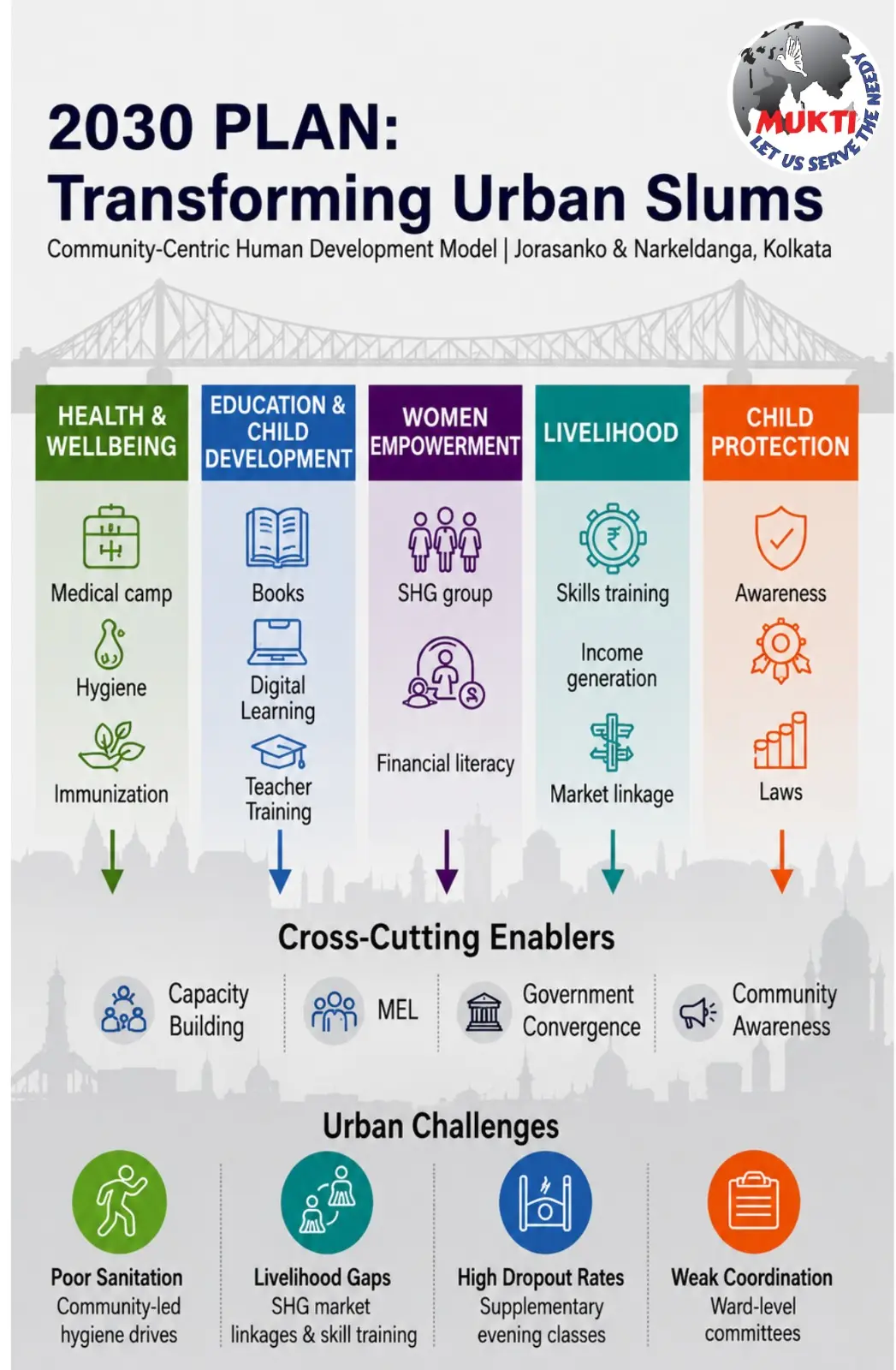
Each component strengthens the other. This creates a cycle of development rather than isolated interventions.
Looking Ahead with Hope
Today, hundreds of children, adolescents, youth, and women are participating in MUKTI’s urban initiatives. Behind every number is a personal journey—a child who continues school, a young person learning new skills, a woman gaining confidence to earn an income, or a family finding support when facing crisis.
Project Activities
- A village for independent and enterprising women (A VIEW) (5)
- About Mukti (11)
- Accreditation (14)
- AGM (63)
- Agriculture Reforms (127)
- Ambulance Service (2)
- Amplifying Community Voices (72)
- Awards (17)
- Awareness and Empowerment (137)
- Awareness drives (61)
- Bio-Village-Kankandighi (10)
- Careers (9)
- Chick Rearing Programme for Marginalised Women (16)
- CHILD (25)
- Climate Resilience River Embankment (46)
- Covid-19 (74)
- Cultural Shows (7)
- Cyclone Aila (13)
- Cyclone Amphan (44)
- Cyclone Bulbul (30)
- Cyclone Dana (3)
- Cyclone Remal (12)
- Cyclone Response & Recovery (90)
- Cyclone Tolerant Houses (15)
- Cyclone Yaas (57)
- Daily Activities USA (25)
- Disaster Recovery (264)
- Editorial (66)
- Editorial by Abir Biswas (1)
- Editorial by Amit Kumar Dey (4)
- Editorial by Ananya Chatterjee (3)
- Editorial by Ankita Kothiyal (5)
- Editorial by Chandrachur Chatterjee (1)
- Editorial by Debabrata Halder (1)
- Editorial by Dr. Alokananda Ghosh Sengupta (2)
- Editorial by Kasturi Bakshi (1)
- Editorial by Monami Mitra (1)
- Editorial by Nandita (4)
- Editorial by Pampa Karmakar (1)
- Editorial by Pranay Patra (1)
- Editorial by Prof. Pradeep Ray (1)
- Editorial by Ranitendranath Tagore (1)
- Editorial by Sankar Halder (15)
- Editorial by Satyajit Ray (8)
- Editorial by Sohini Mehta (1)
- Editorial by Sonamon Basu (3)
- Editorial by Soumitra Bose (3)
- Editorial by Subhankar Basu (1)
- Editorial by Supriya Sarkar (1)
- Editorial by Supriyo Banerjee (4)
- Editorial by Ujjwal Maity (2)
- Education and Enrichment (455)
- Environment and Resilience (130)
- Featured Activities (31)
- Gram Clinic (9)
- Health Water & Sanitation (98)
- HOPE (10)
- Impact Stories List (109)
- Integrated Development (232)
- International Management Institute (IMI) (2)
- Jal hi Kal (6)
- Kitchen Gardening (16)
- Livelihood & Enablement (233)
- MCDF (121)
- Medical Camp (45)
- MIT (8)
- MKSS (57)
- MSS (156)
- Mukti Academia (5)
- Mukti Academy (2)
- Mukti BSI Digital Herberium (1)
- Mukti Craft (18)
- Mukti Cultural (2)
- Mukti Employment Exchange (MEE) (29)
- Mukti Fresh (15)
- Mukti Gram - Egra (11)
- Mukti Gram - Purbashridharpur (171)
- Mukti Green Defense in Sundarbans (11)
- Mukti URBAN (9)
- Mukti USA (2)
- Mukti Yoga (12)
- Mukto Dhara (2)
- Navya (2)
- NIRMAN (2)
- Northumbria University (2)
- Obituary (6)
- Observance Days Celebration (53)
- Organic Farming & Training Support (46)
- Pond Rejuvenation (21)
- Prerana (5)
- Projects For Mukti Wide (7)
- Queen Mary University of London (1)
- Rights and Special Needs (122)
- Run for Cause (13)
- Run4SafeFood (7)
- SDF (6)
- Shahoshini (11)
- Skill & Enterprise Development (21)
- Smart lab (5)
- Social Stock Exchange (2)
- Social Workers' Convention (1)
- Sundarbans Green (SUN-G) (15)
- Sunderban development fair project (4)
- Suraksha Songlap (1)
- Surya (22)
- Sustainable Agriculture Movement (64)
- SWAS-2-0 (21)
- Swastha Shongini (33)
- Swavalamban Accelerator in Sundarbans (SWAS) (21)
- Tour for Cause (52)
- TSS (216)
- UDAAN (9)
- Uncategorized (105)
- University of Calcutta (2)
- Value Education (12)
- Valued Partners (3)
- Vocational Trainings (15)
- VOICE (14)
- Voice Sunderban (2)