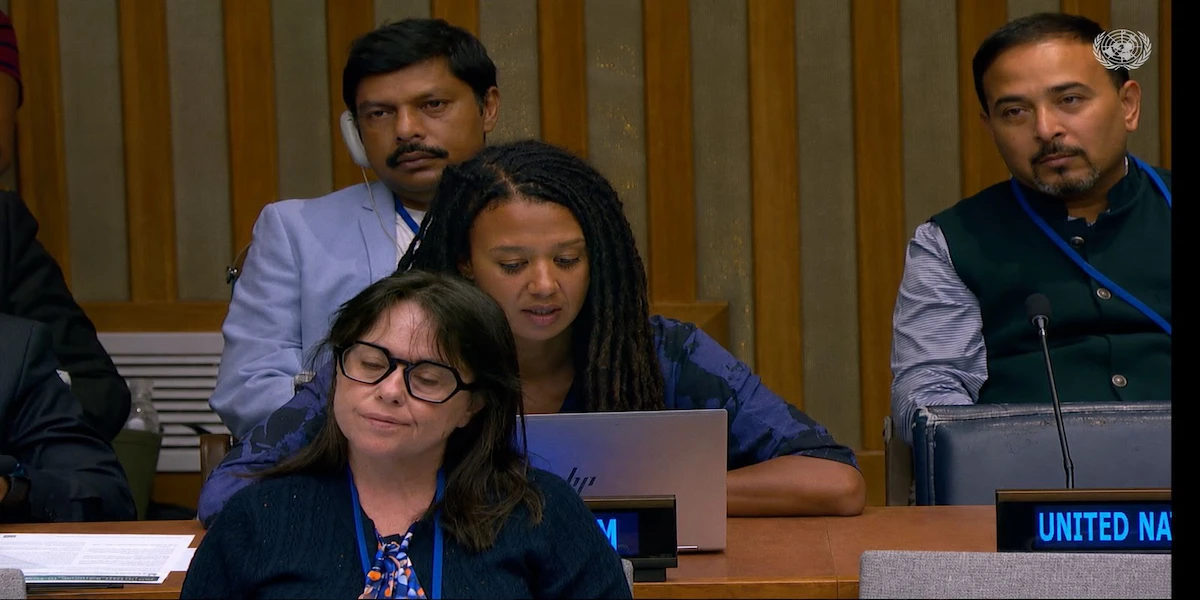
Mukti Participates in UN “Beyond GDP” Dialogue at HLPF 2026 and Raises the Voice of Climate Refugees
On 13 July 2026, Sankar Halder, Founder & President of Mukti, and Satyajit Roy, Secretary of Mukti, participated in the high-level panel discussion “Beyond GDP: Moving from Analysis to Impact” at the Goals Lounge during the High-level Political Forum (HLPF) 2026 at the United Nations Headquarters, New York.
The session brought together policymakers, UN officials, economists, researchers, civil society representatives, and delegates from across the world to discuss how countries can move beyond measuring progress solely through economic growth and adopt a more comprehensive approach to sustainable development.
The central idea behind the Beyond GDP initiative is that while Gross Domestic Product (GDP) remains an important measure of a country’s economic performance, it does not fully reflect the true progress of society. Human development cannot be measured by economic growth alone. A nation’s progress should also be assessed by how people actually live—their physical and mental health, quality of education, safety, equality, environmental conditions, resilience to climate change, access to opportunities, and overall well-being and happiness. The Beyond GDP framework therefore seeks to complement traditional economic indicators with broader measures that place people and the planet at the heart of development, enabling governments to design policies that improve the quality of life for present and future generations.
The discussion highlighted the growing global consensus that GDP alone is not sufficient to measure a nation’s progress. Speakers emphasized the need for complementary indicators that capture people’s well-being, social equity, environmental sustainability, climate resilience, natural capital, and quality of life. The panel also explored how governments are beginning to integrate these broader measures into policymaking, budgeting, and national planning, while the United Nations has launched an inclusive global consultation process to develop a practical Beyond GDP framework that will help shape the future international development agenda beyond 2030.
During the “Beyond GDP: Moving from Analysis to Impact” session, Sankar Halder raised a question that is deeply connected to Mukti’s work in the Sundarbans.
Drawing from Mukti’s grassroots experience, he highlighted that communities in the Sundarbans are already experiencing the harsh realities of climate change. Rising sea levels, cyclones, salinity intrusion, erosion, and the loss of livelihoods are forcing many families to leave their homes, creating a growing population of climate refugees. He emphasized that this is not unique to the Sundarbans but an emerging global challenge affecting vulnerable communities across the world.
Addressing the distinguished panel, Mr. Halder posed the following question:
“As we move beyond GDP as the sole measure of development, how are the suffering, displacement, and loss experienced by climate refugees being recognized? With climate change accelerating and impacts becoming more severe, this issue is likely to become one of the defining humanitarian and development challenges of the coming decades. How should governments and the international community incorporate the wellbeing and resilience of climate-affected populations into future measures of national progress?”
The discussion reinforced an important message: true development cannot be measured only by economic output. It must also account for the wellbeing, dignity, resilience, and future security of people—especially those most vulnerable to the impacts of climate change.
Mukti is grateful for the opportunity to exchange views with fellow participants and delegates from across the globe. During the event, Sankar Halder and Satyajit Roy actively interacted with representatives from various countries, including UN officials, and shared Mukti’s grassroots experiences in promoting sustainable development, climate resilience, community empowerment, education, women’s empowerment, disaster preparedness, and environmental conservation in the Sundarbans.
These meaningful interactions and new connections further strengthened opportunities to showcase Mukti’s community-led development model on the global stage and to foster future collaboration with international organizations, governments, research institutions, and development partners. The discussion also strengthened Mukti’s conviction that future development indicators should recognise not only economic growth but also environmental sustainability, community resilience, and the lives of people who bear the greatest burden of the climate crisis.
Through its continued work in the Sundarbans, Mukti remains committed to advocating for development approaches that place people, communities, and the environment at the centre of sustainable progress. Its participation at the Beyond GDP dialogue reaffirmed the organisation’s commitment to contributing grassroots knowledge and practical solutions to global discussions on sustainable development, ensuring that development is measured not only by economic prosperity but also by the well-being of people and the health of the planet.
Project Activities
- A village for independent and enterprising women (A VIEW) (5)
- About Mukti (11)
- Accreditation (14)
- AGM (63)
- Agriculture Reforms (130)
- Ambulance Service (2)
- Amplifying Community Voices (78)
- Awards (17)
- Awareness and Empowerment (141)
- Awareness drives (64)
- Bio-Village-Kankandighi (10)
- Careers (10)
- Chick Rearing Programme for Marginalised Women (17)
- CHILD (25)
- Climate Resilience River Embankment (46)
- Covid-19 (74)
- Cultural Shows (7)
- Cyclone Aila (13)
- Cyclone Amphan (44)
- Cyclone Bulbul (30)
- Cyclone Dana (3)
- Cyclone Remal (12)
- Cyclone Response & Recovery (90)
- Cyclone Tolerant Houses (15)
- Cyclone Yaas (57)
- Daily Activities USA (25)
- Disaster Recovery (265)
- Editorial (74)
- Editorial by Abir Biswas (1)
- Editorial by Amit Kumar Dey (4)
- Editorial by Ananya Chatterjee (3)
- Editorial by Ankita Kothiyal (6)
- Editorial by Chandrachur Chatterjee (1)
- Editorial by Debabrata Halder (2)
- Editorial by Dr. Alokananda Ghosh Sengupta (2)
- Editorial by Kasturi Bakshi (1)
- Editorial by Monami Mitra (1)
- Editorial by Nandita (4)
- Editorial by Pampa Karmakar (1)
- Editorial by Paramita Panja (1)
- Editorial by Pranay Patra (1)
- Editorial by Prof. Pradeep Ray (1)
- Editorial by Ranitendranath Tagore (2)
- Editorial by Sankar Halder (16)
- Editorial by Satyajit Ray (11)
- Editorial by Sohini Mehta (1)
- Editorial by Sonamon Basu (3)
- Editorial by Soumitra Bose (4)
- Editorial by Subhankar Basu (1)
- Editorial by Supriya Sarkar (1)
- Editorial by Supriyo Banerjee (4)
- Editorial by Ujjwal Maity (2)
- Education and Enrichment (474)
- Environment and Resilience (132)
- Featured Activities (33)
- Gram Clinic (9)
- Health Water & Sanitation (103)
- HOPE (10)
- Impact Stories List (109)
- Integrated Development (248)
- International Management Institute (IMI) (2)
- Jal hi Kal (6)
- KF Mukti Clinic (2)
- Kitchen Gardening (16)
- Livelihood & Enablement (243)
- MCDF (122)
- Medical Camp (48)
- MIT (8)
- MKSS (64)
- MSS (162)
- Mukti (1)
- Mukti Academia (5)
- Mukti Academy (2)
- Mukti BSI Digital Herberium (1)
- Mukti Craft (18)
- Mukti Cultural (2)
- Mukti Employment Exchange (MEE) (29)
- Mukti Fresh (15)
- Mukti Gram - Egra (12)
- Mukti Gram - Purbashridharpur (172)
- Mukti Green Defense in Sundarbans (12)
- Mukti Switzerland (1)
- Mukti URBAN (19)
- Mukti USA (2)
- Mukti Yoga (12)
- Mukto Dhara (2)
- Navya (3)
- NIRMAN (5)
- Northumbria University (2)
- Obituary (6)
- Observance Days Celebration (54)
- Organic Farming & Training Support (49)
- Pond Rejuvenation (21)
- Prerana (5)
- Projects For Mukti Wide (8)
- Queen Mary University of London (1)
- Rights and Special Needs (134)
- Run for Cause (16)
- Run4SafeFood (11)
- SDF (6)
- Shahoshini (16)
- Skill & Enterprise Development (21)
- Smart lab (5)
- Social Stock Exchange (2)
- Social Workers' Convention (1)
- Sundarbans Green (SUN-G) (15)
- Sunderban development fair project (4)
- Suraksha Songlap (4)
- Surya (29)
- Sustainable Agriculture Movement (67)
- SWAS-2-0 (24)
- Swastha Shongini (33)
- Swavalamban Accelerator in Sundarbans (SWAS) (23)
- Tour for Cause (52)
- TSS (222)
- UDAAN (9)
- Uncategorized (109)
- University of Calcutta (2)
- Value Education (13)
- Valued Partners (3)
- Vocational Trainings (15)
- VOICE (15)
- Voice Sunderban (2)