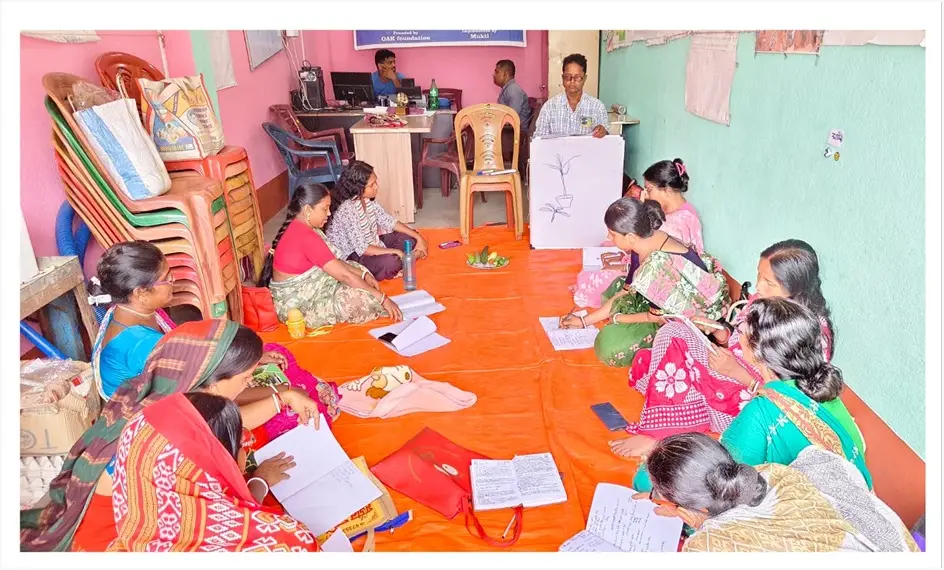
CRP Training Strengthens Knowledge on Seed Conservation and Sustainable Agriculture
A two-day Community Resource Person (CRP) training on “Seed Collection and Preservation” was organized from 18th to 19th May 2026 with the objective of enhancing participants’ knowledge and practical skills in seed conservation, sustainable agriculture, and climate-resilient farming practices. The training brought together community members and grassroots leaders who play an important role in supporting farmers and promoting sustainable agricultural practices within their villages.
The programme focused on the critical importance of preserving indigenous and locally adapted seed varieties, which have long been the foundation of rural agriculture. Participants learned how traditional seeds not only help maintain biodiversity but also contribute to food security, reduce farming costs, and strengthen farmers’ resilience against climate-related challenges such as irregular rainfall, salinity, pests, and changing weather conditions.
The training sessions covered a wide range of topics related to seed conservation and production. Participants were introduced to the differences between seed production and crop production, seed classification systems, various types of seeds, and factors affecting seed viability and germination. Discussions also highlighted the roles played by farmers, government institutions, and private organizations in the overall seed production and distribution system.
Special emphasis was placed on practical learning. Participants were trained to identify healthy and quality seeds suitable for preservation and future cultivation. They learned about monocot and dicot plants, seasonal crop classification, and appropriate methods for selecting, collecting, cleaning, drying, and storing seeds to maintain their quality over extended periods. Demonstrations and hands-on activities enabled participants to gain practical experience and develop confidence in applying these techniques within their own communities.
The programme also highlighted the growing importance of sustainable and environmentally friendly agricultural practices. Participants were introduced to organic pest and disease management methods, natural farming techniques, and alternatives to chemical-based agricultural inputs. Discussions focused on how reducing dependence on harmful chemicals can improve soil health, protect local ecosystems, reduce production costs, and contribute to healthier food systems.
An important aspect of the training was the promotion of community-level seed conservation efforts. Participants discussed how village seed banks and collective seed preservation initiatives can help farmers access quality seeds locally, particularly during emergencies or adverse climatic conditions. Such initiatives can play a significant role in strengthening agricultural self-reliance and reducing dependence on external seed sources.
The training provided an important platform for knowledge sharing and collective learning among participants. Through interactive discussions, practical exercises, and field-based examples, community members gained a deeper understanding of the connection between seed conservation, environmental sustainability, and long-term livelihood security.
By strengthening local capacities in seed preservation and sustainable farming, the programme contributes towards building climate-resilient rural communities, promoting agricultural biodiversity, and empowering farmers with the knowledge needed to safeguard their traditional agricultural heritage for future generations.
Project Activities
- A village for independent and enterprising women (A VIEW) (5)
- About Mukti (11)
- Accreditation (14)
- AGM (63)
- Agriculture Reforms (127)
- Ambulance Service (2)
- Amplifying Community Voices (75)
- Awards (17)
- Awareness and Empowerment (138)
- Awareness drives (61)
- Bio-Village-Kankandighi (10)
- Careers (10)
- Chick Rearing Programme for Marginalised Women (16)
- CHILD (25)
- Climate Resilience River Embankment (46)
- Covid-19 (74)
- Cultural Shows (7)
- Cyclone Aila (13)
- Cyclone Amphan (44)
- Cyclone Bulbul (30)
- Cyclone Dana (3)
- Cyclone Remal (12)
- Cyclone Response & Recovery (90)
- Cyclone Tolerant Houses (15)
- Cyclone Yaas (57)
- Daily Activities USA (25)
- Disaster Recovery (264)
- Editorial (69)
- Editorial by Abir Biswas (1)
- Editorial by Amit Kumar Dey (4)
- Editorial by Ananya Chatterjee (3)
- Editorial by Ankita Kothiyal (5)
- Editorial by Chandrachur Chatterjee (1)
- Editorial by Debabrata Halder (1)
- Editorial by Dr. Alokananda Ghosh Sengupta (2)
- Editorial by Kasturi Bakshi (1)
- Editorial by Monami Mitra (1)
- Editorial by Nandita (4)
- Editorial by Pampa Karmakar (1)
- Editorial by Paramita Panja (1)
- Editorial by Pranay Patra (1)
- Editorial by Prof. Pradeep Ray (1)
- Editorial by Ranitendranath Tagore (1)
- Editorial by Sankar Halder (16)
- Editorial by Satyajit Ray (10)
- Editorial by Sohini Mehta (1)
- Editorial by Sonamon Basu (3)
- Editorial by Soumitra Bose (3)
- Editorial by Subhankar Basu (1)
- Editorial by Supriya Sarkar (1)
- Editorial by Supriyo Banerjee (4)
- Editorial by Ujjwal Maity (2)
- Education and Enrichment (460)
- Environment and Resilience (132)
- Featured Activities (32)
- Gram Clinic (9)
- Health Water & Sanitation (101)
- HOPE (10)
- Impact Stories List (109)
- Integrated Development (239)
- International Management Institute (IMI) (2)
- Jal hi Kal (6)
- KF Mukti Clinic (2)
- Kitchen Gardening (16)
- Livelihood & Enablement (235)
- MCDF (122)
- Medical Camp (46)
- MIT (8)
- MKSS (59)
- MSS (157)
- Mukti Academia (5)
- Mukti Academy (2)
- Mukti BSI Digital Herberium (1)
- Mukti Craft (18)
- Mukti Cultural (2)
- Mukti Employment Exchange (MEE) (29)
- Mukti Fresh (15)
- Mukti Gram - Egra (12)
- Mukti Gram - Purbashridharpur (172)
- Mukti Green Defense in Sundarbans (12)
- Mukti URBAN (13)
- Mukti USA (2)
- Mukti Yoga (12)
- Mukto Dhara (2)
- Navya (2)
- NIRMAN (4)
- Northumbria University (2)
- Obituary (6)
- Observance Days Celebration (54)
- Organic Farming & Training Support (46)
- Pond Rejuvenation (21)
- Prerana (5)
- Projects For Mukti Wide (7)
- Queen Mary University of London (1)
- Rights and Special Needs (128)
- Run for Cause (14)
- Run4SafeFood (9)
- SDF (6)
- Shahoshini (14)
- Skill & Enterprise Development (21)
- Smart lab (5)
- Social Stock Exchange (2)
- Social Workers' Convention (1)
- Sundarbans Green (SUN-G) (15)
- Sunderban development fair project (4)
- Suraksha Songlap (1)
- Surya (24)
- Sustainable Agriculture Movement (64)
- SWAS-2-0 (21)
- Swastha Shongini (33)
- Swavalamban Accelerator in Sundarbans (SWAS) (21)
- Tour for Cause (52)
- TSS (219)
- UDAAN (9)
- Uncategorized (107)
- University of Calcutta (2)
- Value Education (12)
- Valued Partners (3)
- Vocational Trainings (15)
- VOICE (14)
- Voice Sunderban (2)