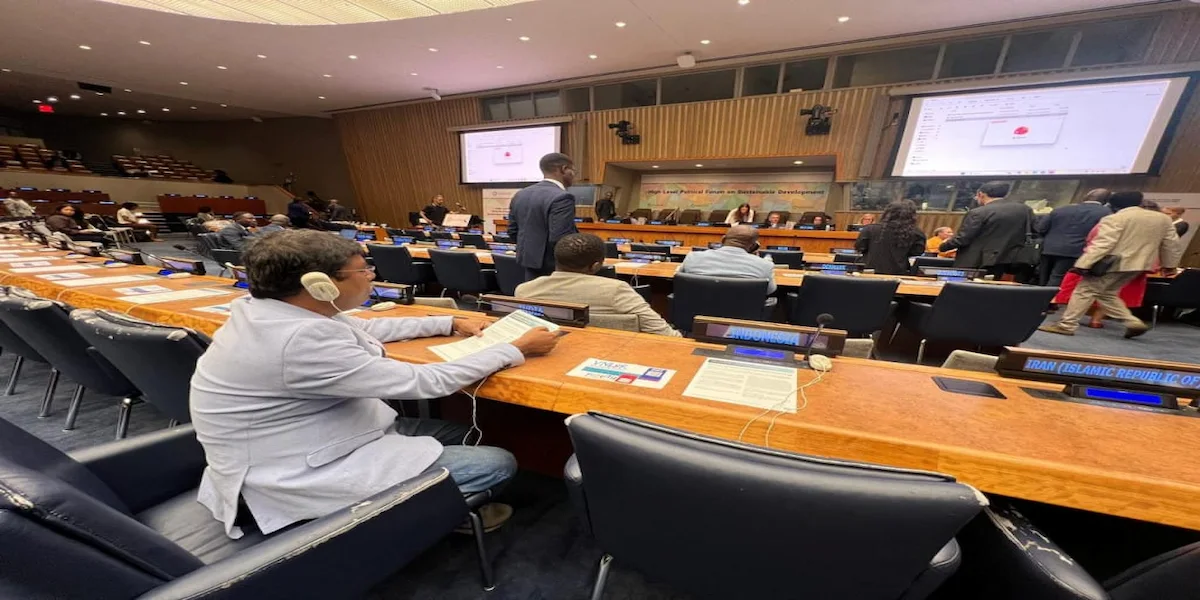
Mukti Strengthens Global Engagement at the United Nations High-level Political Forum (HLPF) 2026
New York, USA | 7–15 July 2026
Mukti proudly marked another significant milestone on the global stage through its active participation in the 2026 High-level Political Forum (HLPF) on Sustainable Development, organised under the auspices of the United Nations Economic and Social Council (ECOSOC) at the United Nations Headquarters, New York. Representing the organisation, Sankar Halder, Founder & President of Mukti, and Satyajit Roy, Secretary of Mukti, participated in the Forum on 7th, 8th, 13th, and 14th July 2026, attending high-level discussions, official country presentations, thematic dialogues, and interactive sessions with government representatives, UN officials, development practitioners, researchers, civil society organisations, and international partners.
Held from 7th to 15th July 2026, the HLPF is the United Nations’ premier annual platform for reviewing global progress towards achieving the 2030 Agenda for Sustainable Development and the Sustainable Development Goals (SDGs). This year’s theme, “Transformative, equitable, innovative and coordinated actions for the 2030 Agenda for Sustainable Development and its Sustainable Development Goals for a sustainable future for all,” emphasised the urgent need for collaborative global action to accelerate sustainable development.
The Forum brought together heads of governments, ministers, UN agencies, business leaders, scientists, policymakers, development experts, and civil society organisations from across the world to exchange experiences, review progress, and strengthen partnerships for achieving the SDGs. Particular focus during HLPF 2026 was given to SDG 6 (Clean Water and Sanitation), SDG 7 (Affordable and Clean Energy), SDG 9 (Industry, Innovation and Infrastructure), SDG 11 (Sustainable Cities and Communities), and SDG 17 (Partnerships for the Goals). Thirty-six countries presented their Voluntary National Reviews (VNRs), highlighting achievements, challenges, and future commitments towards sustainable development.
As an NGO in consultative status with ECOSOC, Mukti’s participation reflects its growing recognition within the international development community. The Forum provided an invaluable opportunity to engage with international stakeholders, gain insights into emerging global sustainability strategies, and explore collaborations that can further strengthen grassroots development initiatives.
Throughout the Forum, Mukti representatives attended several country presentations and thematic discussions focusing on innovative approaches towards sustainable development. National delegations, including Senegal and Italy, presented their Voluntary National Reviews, showcasing their progress, challenges, and strategies for implementing the Sustainable Development Goals.
Senegal highlighted achievements in sustainable transport, climate action, food security, rural development, water resource management, and institutional reforms, emphasising community-centred development and integrated governance. Italy underscored the importance of policy coherence, culture as a driver of sustainable development, youth participation, innovation, and strong partnerships across different levels of governance. Another participating country demonstrated its whole-of-government approach towards sustainable development by integrating science, research, innovation, healthcare, education, food security, water and sanitation, and international cooperation into national policy frameworks.
Across all the country presentations, a common message emerged: achieving the Sustainable Development Goals requires integrated, people-centred, and partnership-driven approaches rather than isolated interventions. Governments increasingly recognised that sustainable development depends upon climate resilience, quality education, accessible healthcare, sustainable agriculture, environmental conservation, gender equality, digital innovation, strong institutions, and active community participation.
These priorities closely resonate with Mukti’s philosophy of integrated rural development.
For more than two decades, Mukti has been working towards sustainable and inclusive development through initiatives in education, healthcare, livelihood generation, sustainable agriculture, disaster management, climate resilience, digital inclusion, women empowerment, renewable energy, environmental conservation, child development, and rural development. Through its HEALER AID framework, the organisation addresses multiple dimensions of sustainable development, positively impacting more than one million people across the Sundarbans and other vulnerable regions of West Bengal.
Mukti’s Sustainable Agriculture Movement promotes organic farming, climate-resilient agriculture, water conservation, soil restoration, farmer capacity building, and improved market access through initiatives such as Mukti Fresh. Similarly, its work in education, healthcare, digital inclusion, women-led Self Help Groups, disaster preparedness, mangrove restoration, renewable energy promotion, and community participation demonstrates how grassroots initiatives can contribute directly towards achieving the Sustainable Development Goals.
During the Forum, Sankar Halder and Satyajit Roy actively interacted with delegates, UN officials, development experts, researchers, and representatives of civil society organisations from different countries. These exchanges provided valuable opportunities to share Mukti’s grassroots experiences from the climate-vulnerable Sundarbans, learn from international best practices, and explore future collaborations in climate resilience, sustainable agriculture, integrated rural development, community-led innovation, education, and youth engagement.
One of the significant highlights of Mukti’s participation came during the “Beyond GDP: Moving from Analysis to Impact” dialogue at the UN Goals Lounge, where the organisation contributed to an important global conversation on redefining how development is measured.
The central idea behind the Beyond GDP initiative is that while Gross Domestic Product (GDP) remains an important measure of a country’s economic performance, it does not fully capture the true progress of society. Human development must also be assessed through indicators such as health, education, equality, environmental sustainability, climate resilience, safety, access to opportunities, and overall well-being. The initiative seeks to complement traditional economic measures with broader indicators that place people and the planet at the centre of development.
During the discussion, Sankar Halder drew attention to one of the most pressing consequences of climate change—the growing challenge of climate-induced displacement. Drawing from Mukti’s decades of work in the Sundarbans, he highlighted how rising sea levels, cyclones, salinity intrusion, riverbank erosion, and the loss of livelihoods are forcing many families to leave their homes, creating a growing population of climate refugees. He emphasised that this is not only a challenge for the Sundarbans but an emerging global humanitarian issue affecting vulnerable communities worldwide.
Addressing the distinguished panel, Mr. Halder asked:
“As we move beyond GDP as the sole measure of development, how are the suffering, displacement, and loss experienced by climate refugees being recognized? With climate change accelerating and impacts becoming more severe, this issue is likely to become one of the defining humanitarian and development challenges of the coming decades. How should governments and the international community incorporate the wellbeing and resilience of climate-affected populations into future measures of national progress?”
The discussion reinforced an important message that true development cannot be measured solely by economic growth. It must also recognise the wellbeing, dignity, resilience, and future security of people, particularly those most vulnerable to the impacts of climate change.
Speaking on Mukti’s participation at HLPF 2026, Sankar Halder, Founder & President of Mukti, said:
“The Sustainable Development Goals can only be achieved when global vision is translated into local action. Mukti has always believed that empowering communities at the grassroots is the foundation of sustainable development. Participating in HLPF 2026 enables us to learn from global best practices while sharing our experiences from rural India.”
Satyajit Roy, Secretary of Mukti, added:
“The HLPF provides an invaluable platform for networking, knowledge exchange and building partnerships. Mukti remains committed to contributing towards the global SDG agenda through innovative, scalable and community-driven solutions.”
Mukti is grateful for the opportunity to participate in these important global discussions and exchange ideas with government representatives, UN officials, researchers, development practitioners, and civil society leaders from around the world. These meaningful interactions have strengthened opportunities to showcase Mukti’s community-led development model internationally while fostering future collaborations with governments, research institutions, development agencies, and global partners.
As the world works towards achieving the Sustainable Development Goals by 2030, Mukti remains committed to translating global commitments into meaningful grassroots action. The organisation firmly believes that sustainable development begins within communities and that lasting change can only be achieved through inclusive participation, innovation, strong partnerships, and collective responsibility. Its participation in the United Nations High-level Political Forum 2026 reflects Mukti’s growing international engagement and its unwavering commitment to building a more resilient, equitable, and sustainable future for all.