World Mangrove Day 2026: MUKTI Unites Communities, Conservation, and Collaboration to Safeguard the Sundarbans
26 July 2026 | South 24 Parganas, West Bengal
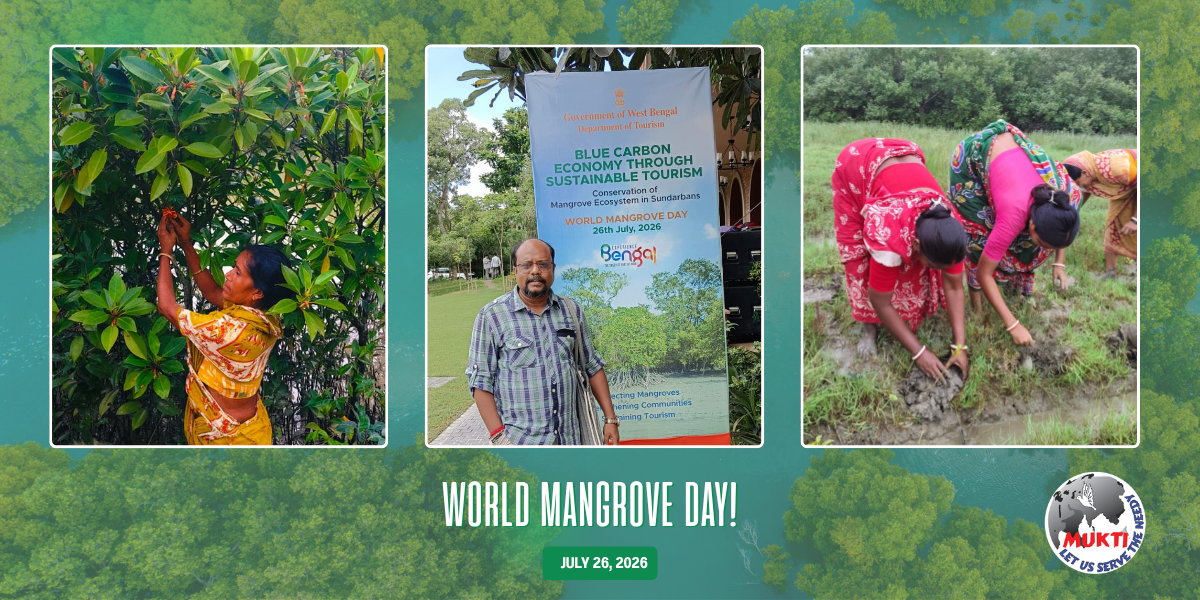
On the occasion of the International Day for the Conservation of the Mangrove Ecosystem (World Mangrove Day), MUKTI commemorated the day through a series of impactful initiatives across South 24 Parganas, reaffirming its commitment to protecting the fragile mangrove ecosystem of the Sundarbans. Through community awareness programmes, symbolic conservation activities, large-scale plantation drives, and participation in a state-level awareness workshop, the organisation brought together local communities, government representatives, youth, women, and environmental stakeholders to strengthen collective action for coastal resilience.
Mangroves are far more than forests—they are the lifeline of the Sundarbans. They act as natural bio-shields against cyclones, tidal surges, and coastal erosion, while supporting biodiversity, sustaining livelihoods, sequestering carbon, and maintaining ecological balance. As climate change continues to intensify the vulnerability of coastal regions, conserving and restoring mangrove ecosystems has become more critical than ever.
Community Awareness and Mangrove Plantation at Heramba Gopalpur
As part of the observance, MUKTI organised an awareness programme at Khudiram Basu Shishu Shiksha Kendra, Heramba Gopalpur, under the ACV Project. The programme was jointly organised by the ACV Climate Club Adolescent Group, Women Leaders, PAR Group, and Farmers’ Group, bringing together approximately 50 participants, including adolescent boys and girls, teachers, community members, and local stakeholders.
The awareness session focused on the ecological and social significance of mangroves in the Sundarbans. Participants discussed how mangrove forests:
- Protect coastal areas from erosion.
- Reduce the impact of cyclones and tidal surges.
- Strengthen embankments through their extensive root systems.
- Absorb large quantities of atmospheric carbon, helping mitigate climate change.
- Maintain ecological balance and support rich biodiversity.
- Safeguard the unique riverine ecosystem of the Sundarbans.
The programme also highlighted the responsibility of local communities in preserving these invaluable ecosystems for future generations.
Following the awareness session, participants joined hands to plant 500 mangrove saplings, symbolising their shared commitment to restoring and protecting the coastal landscape.
“Amar Gachh, Amar Paribar”: Celebrating Conservation Through Community Culture
Simultaneously, MUKTI organised another unique celebration at Purba Sridharpur under the inspiring theme “Amar Gachh, Amar Paribar” (My Tree, My Family).
This initiative transformed environmental conservation into a community movement by encouraging villagers to build a lifelong emotional connection with mangrove trees. Inspired by Rabindranath Tagore’s Raksha Bandhan tradition, participants tied handcrafted biodegradable Badar Rakhis to mature mangrove trees and newly planted saplings, symbolising a sacred pledge to protect the forests that protect their homes and livelihoods.
The celebration followed a 100% plastic-free and zero-cost approach, with all Rakhis prepared using natural wool, recycled jute fibres, and cotton fabric scraps. Children and youth actively participated in preparing and dispersing organic seed balls made from estuarine mud, compost, and naturally collected mangrove propagules to support natural regeneration along vulnerable embankments.
Women-led Self-Help Groups played a leading role in adopting and caring for newly planted saplings, reinforcing long-term community stewardship and ensuring greater survival of young mangrove plants. The initiative beautifully demonstrated how traditional cultural values can strengthen environmental conservation through community ownership.
Large-Scale Coastal Restoration Initiative
These celebrations form part of MUKTI’s broader climate resilience programme across the Sundarbans. As part of this week’s conservation efforts, the organisation is undertaking the plantation of 10,000 mangrove saplings and 15,000 vetiver grass saplings across vulnerable coastal locations.
While mangroves serve as the first line of defence against cyclones, tidal surges, and coastal erosion, vetiver grass complements these efforts by stabilising embankments with its deep and extensive root system, reducing soil erosion and strengthening the region’s natural resilience against climate-related disasters.
Together, these large-scale plantation activities represent an integrated, nature-based solution for protecting both ecosystems and coastal communities.
MUKTI Participates in State-Level World Mangrove Day Awareness Workshop
Further strengthening its commitment to mangrove conservation, representatives from MUKTI also participated in a World Mangrove Day Awareness Workshop organised by the West Bengal Tourism Department at the Royal Pavilion, Taj Ganges Kutir, Raichak, South 24 Parganas.
The programme brought together government officials, environmental stakeholders, and conservation practitioners to discuss the importance of protecting the Sundarbans’ unique mangrove ecosystem.
Addressing the gathering, Dr. Shankar Ghosh, Honourable Minister, emphasised the crucial role of mangrove conservation in combating climate change and protecting the rich biodiversity of the Sundarbans. He also highlighted the importance of promoting eco-friendly tourism as a means of empowering local communities while ensuring environmental sustainability.
The workshop was also graced by several distinguished dignitaries, including:
- Smt. Purnima Chakraborty, Minister of State.
- Shri Barun Kumar Ray, I.A.S., Additional Chief Secretary, Tourism Department.
- Mr. Dipankar Jana, Minister of State for Kakdwip, Government of West Bengal.
The workshop provided an important platform for dialogue and collaboration among government departments, civil society organisations, and community stakeholders, reinforcing the shared responsibility of conserving one of the world’s most significant mangrove ecosystems.
A Shared Commitment to the Future
This year’s World Mangrove Day demonstrated that effective conservation is built on collaboration. From empowering adolescents and local communities through awareness programmes, to inspiring stewardship through cultural traditions, undertaking large-scale ecological restoration, and engaging with government-led conservation initiatives, MUKTI’s observance reflected a holistic approach to safeguarding the Sundarbans.
Every sapling planted, every awareness session conducted, every community pledge made, and every collaborative dialogue contributes to strengthening the natural bio-shield that protects millions of lives across the delta.
As climate challenges continue to grow, MUKTI remains committed to working alongside communities, institutions, and government partners to preserve the mangroves of the Sundarbans—ensuring that these invaluable ecosystems continue to protect biodiversity, sustain livelihoods, and build resilience for generations to come.
Project Activities
- A village for independent and enterprising women (A VIEW) (5)
- About Mukti (11)
- Accreditation (14)
- AGM (63)
- Agriculture Reforms (130)
- Ambulance Service (2)
- Amplifying Community Voices (77)
- Awards (17)
- Awareness and Empowerment (141)
- Awareness drives (64)
- Bio-Village-Kankandighi (10)
- Careers (10)
- Chick Rearing Programme for Marginalised Women (17)
- CHILD (25)
- Climate Resilience River Embankment (46)
- Covid-19 (74)
- Cultural Shows (7)
- Cyclone Aila (13)
- Cyclone Amphan (44)
- Cyclone Bulbul (30)
- Cyclone Dana (3)
- Cyclone Remal (12)
- Cyclone Response & Recovery (90)
- Cyclone Tolerant Houses (15)
- Cyclone Yaas (57)
- Daily Activities USA (25)
- Disaster Recovery (265)
- Editorial (73)
- Editorial by Abir Biswas (1)
- Editorial by Amit Kumar Dey (4)
- Editorial by Ananya Chatterjee (3)
- Editorial by Ankita Kothiyal (5)
- Editorial by Chandrachur Chatterjee (1)
- Editorial by Debabrata Halder (2)
- Editorial by Dr. Alokananda Ghosh Sengupta (2)
- Editorial by Kasturi Bakshi (1)
- Editorial by Monami Mitra (1)
- Editorial by Nandita (4)
- Editorial by Pampa Karmakar (1)
- Editorial by Paramita Panja (1)
- Editorial by Pranay Patra (1)
- Editorial by Prof. Pradeep Ray (1)
- Editorial by Ranitendranath Tagore (2)
- Editorial by Sankar Halder (16)
- Editorial by Satyajit Ray (11)
- Editorial by Sohini Mehta (1)
- Editorial by Sonamon Basu (3)
- Editorial by Soumitra Bose (4)
- Editorial by Subhankar Basu (1)
- Editorial by Supriya Sarkar (1)
- Editorial by Supriyo Banerjee (4)
- Editorial by Ujjwal Maity (2)
- Education and Enrichment (471)
- Environment and Resilience (132)
- Featured Activities (32)
- Gram Clinic (9)
- Health Water & Sanitation (103)
- HOPE (10)
- Impact Stories List (109)
- Integrated Development (247)
- International Management Institute (IMI) (2)
- Jal hi Kal (6)
- KF Mukti Clinic (2)
- Kitchen Gardening (16)
- Livelihood & Enablement (242)
- MCDF (122)
- Medical Camp (48)
- MIT (8)
- MKSS (62)
- MSS (161)
- Mukti Academia (5)
- Mukti Academy (2)
- Mukti BSI Digital Herberium (1)
- Mukti Craft (18)
- Mukti Cultural (2)
- Mukti Employment Exchange (MEE) (29)
- Mukti Fresh (15)
- Mukti Gram - Egra (12)
- Mukti Gram - Purbashridharpur (172)
- Mukti Green Defense in Sundarbans (12)
- Mukti URBAN (18)
- Mukti USA (2)
- Mukti Yoga (12)
- Mukto Dhara (2)
- Navya (3)
- NIRMAN (5)
- Northumbria University (2)
- Obituary (6)
- Observance Days Celebration (54)
- Organic Farming & Training Support (49)
- Pond Rejuvenation (21)
- Prerana (5)
- Projects For Mukti Wide (7)
- Queen Mary University of London (1)
- Rights and Special Needs (132)
- Run for Cause (16)
- Run4SafeFood (11)
- SDF (6)
- Shahoshini (15)
- Skill & Enterprise Development (21)
- Smart lab (5)
- Social Stock Exchange (2)
- Social Workers' Convention (1)
- Sundarbans Green (SUN-G) (15)
- Sunderban development fair project (4)
- Suraksha Songlap (3)
- Surya (29)
- Sustainable Agriculture Movement (67)
- SWAS-2-0 (23)
- Swastha Shongini (33)
- Swavalamban Accelerator in Sundarbans (SWAS) (22)
- Tour for Cause (52)
- TSS (222)
- UDAAN (9)
- Uncategorized (109)
- University of Calcutta (2)
- Value Education (13)
- Valued Partners (3)
- Vocational Trainings (15)
- VOICE (15)
- Voice Sunderban (2)