Understanding Needs, Building Possibilities: MUKTI’s Field Assessment in Binpur-I
Engaging with Lodha and Shabar communities to understand priorities in education, health, livelihoods and holistic community development
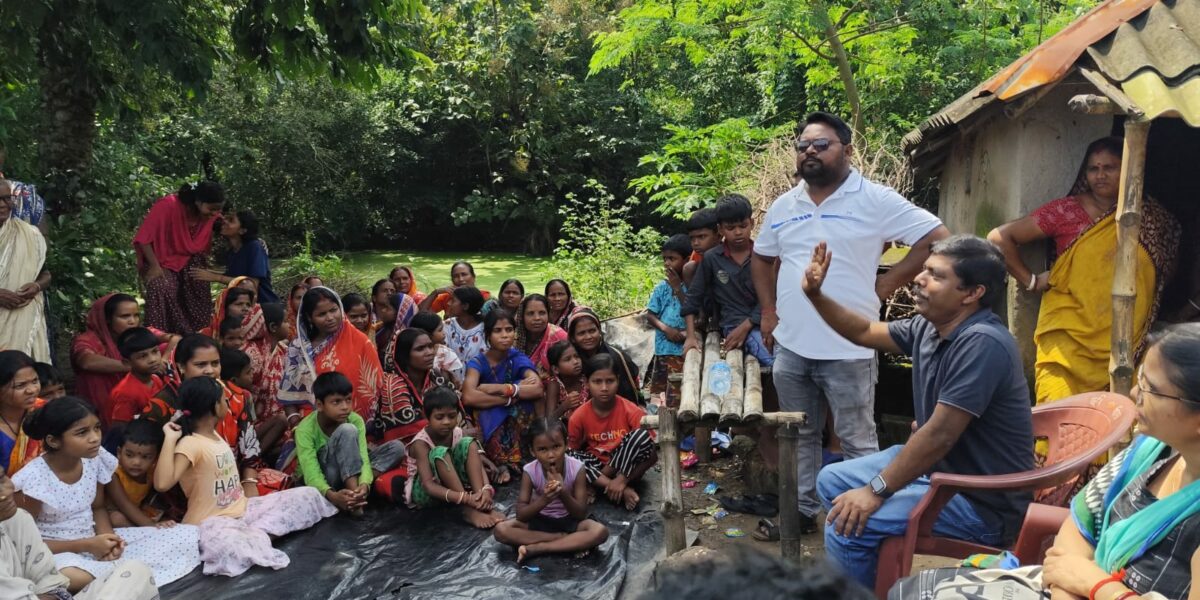
As part of a two-day field visit to Jhargram, Mr. Sankar Halder, Founder-President of MUKTI, visited several areas of Binpur-I Block inhabited by Lodha and Shabar communities. The visit aimed to develop a deeper understanding of the communities’ living conditions, educational needs, health concerns, livelihood practices, and key socio-economic challenges through direct engagement with community members and local stakeholders.
Rather than approaching development in isolation, the visit focused on understanding the communities within their existing social and cultural context. Particular attention was given to exploring ways of improving quality of life while respecting and building upon their existing social structures, traditional practices, knowledge, and skills.
Discussions with community members explored potential areas of intervention, including children’s education, health awareness, skill development, livelihood enhancement, and community empowerment.
Meeting with the BDO of Binpur-I
As part of the field engagement, Mr. Sankar Halder also met with the Block Development Officer (BDO) of Binpur-I to discuss the needs and development priorities of tribal communities in the region, with particular focus on the Lodha and Shabar communities.
The discussion explored possibilities for future initiatives that could address needs across education, health, livelihoods, and social development while ensuring that the communities’ traditions and existing cultural practices remain an important consideration in planning interventions.
The interaction with the Block administration also helped strengthen the understanding of local priorities and the scope for coordinated, community-focused development efforts in Binpur-I.
Understanding Education at the Grassroots
An important part of the visit was an interaction at a Mukti Support School (MSS), where Mr. Sankar Halder met students and teachers to understand the existing educational environment and the challenges children face in continuing their education.
Conversations focused on students’ learning needs, regularity and continuity of education, classroom experiences, and areas where additional educational support may be required.
The visit also included discussions on the school’s existing infrastructure and educational facilities. Teachers shared their field-level experiences, challenges, and suggestions on how the learning environment could be strengthened to better support children and encourage their continued engagement with education.
Listening to Communities, Understanding Priorities
Direct conversations with members of the Lodha and Shabar communities provided important insights into their everyday realities. These interactions helped identify concerns and opportunities across education, health, livelihoods, skills, and social development.
Special attention was given to understanding how children can remain connected with formal education, how access to health information and awareness can be strengthened, and how livelihood opportunities can be developed around existing community skills and traditional practices.
The interactions also reinforced the importance of ensuring that future development efforts are shaped by the needs, experiences, and aspirations expressed by the communities themselves.
Towards Community-Centred Development
Based on the field-level observations and discussions, possibilities were explored for developing an integrated and community-centred approach encompassing education, health, skills, livelihoods, and broader social development.
The two-day field engagement provided MUKTI with valuable insights into both the challenges faced by the Lodha and Shabar communities and the strengths and potential that already exist within them.
These learnings will contribute to the exploration and planning of need-based, locally relevant, and long-term development initiatives in Binpur-I Block, with an emphasis on strengthening opportunities while respecting the communities’ identity, knowledge, and way of life.
Through continued dialogue and grassroots engagement, MUKTI aims to work towards development approaches that are participatory, inclusive, and rooted in the realities and aspirations of the communities they are intended to serve.
Project Activities
- A village for independent and enterprising women (A VIEW) (5)
- About Mukti (11)
- Accreditation (14)
- AGM (63)
- Agriculture Reforms (130)
- Ambulance Service (2)
- Amplifying Community Voices (77)
- Awards (17)
- Awareness and Empowerment (141)
- Awareness drives (64)
- Bio-Village-Kankandighi (10)
- Careers (10)
- Chick Rearing Programme for Marginalised Women (17)
- CHILD (25)
- Climate Resilience River Embankment (46)
- Covid-19 (74)
- Cultural Shows (7)
- Cyclone Aila (13)
- Cyclone Amphan (44)
- Cyclone Bulbul (30)
- Cyclone Dana (3)
- Cyclone Remal (12)
- Cyclone Response & Recovery (90)
- Cyclone Tolerant Houses (15)
- Cyclone Yaas (57)
- Daily Activities USA (25)
- Disaster Recovery (265)
- Editorial (73)
- Editorial by Abir Biswas (1)
- Editorial by Amit Kumar Dey (4)
- Editorial by Ananya Chatterjee (3)
- Editorial by Ankita Kothiyal (5)
- Editorial by Chandrachur Chatterjee (1)
- Editorial by Debabrata Halder (2)
- Editorial by Dr. Alokananda Ghosh Sengupta (2)
- Editorial by Kasturi Bakshi (1)
- Editorial by Monami Mitra (1)
- Editorial by Nandita (4)
- Editorial by Pampa Karmakar (1)
- Editorial by Paramita Panja (1)
- Editorial by Pranay Patra (1)
- Editorial by Prof. Pradeep Ray (1)
- Editorial by Ranitendranath Tagore (2)
- Editorial by Sankar Halder (16)
- Editorial by Satyajit Ray (11)
- Editorial by Sohini Mehta (1)
- Editorial by Sonamon Basu (3)
- Editorial by Soumitra Bose (4)
- Editorial by Subhankar Basu (1)
- Editorial by Supriya Sarkar (1)
- Editorial by Supriyo Banerjee (4)
- Editorial by Ujjwal Maity (2)
- Education and Enrichment (471)
- Environment and Resilience (132)
- Featured Activities (32)
- Gram Clinic (9)
- Health Water & Sanitation (103)
- HOPE (10)
- Impact Stories List (109)
- Integrated Development (247)
- International Management Institute (IMI) (2)
- Jal hi Kal (6)
- KF Mukti Clinic (2)
- Kitchen Gardening (16)
- Livelihood & Enablement (242)
- MCDF (122)
- Medical Camp (48)
- MIT (8)
- MKSS (62)
- MSS (161)
- Mukti Academia (5)
- Mukti Academy (2)
- Mukti BSI Digital Herberium (1)
- Mukti Craft (18)
- Mukti Cultural (2)
- Mukti Employment Exchange (MEE) (29)
- Mukti Fresh (15)
- Mukti Gram - Egra (12)
- Mukti Gram - Purbashridharpur (172)
- Mukti Green Defense in Sundarbans (12)
- Mukti URBAN (18)
- Mukti USA (2)
- Mukti Yoga (12)
- Mukto Dhara (2)
- Navya (3)
- NIRMAN (5)
- Northumbria University (2)
- Obituary (6)
- Observance Days Celebration (54)
- Organic Farming & Training Support (49)
- Pond Rejuvenation (21)
- Prerana (5)
- Projects For Mukti Wide (7)
- Queen Mary University of London (1)
- Rights and Special Needs (132)
- Run for Cause (16)
- Run4SafeFood (11)
- SDF (6)
- Shahoshini (15)
- Skill & Enterprise Development (21)
- Smart lab (5)
- Social Stock Exchange (2)
- Social Workers' Convention (1)
- Sundarbans Green (SUN-G) (15)
- Sunderban development fair project (4)
- Suraksha Songlap (3)
- Surya (29)
- Sustainable Agriculture Movement (67)
- SWAS-2-0 (23)
- Swastha Shongini (33)
- Swavalamban Accelerator in Sundarbans (SWAS) (22)
- Tour for Cause (52)
- TSS (222)
- UDAAN (9)
- Uncategorized (109)
- University of Calcutta (2)
- Value Education (13)
- Valued Partners (3)
- Vocational Trainings (15)
- VOICE (15)
- Voice Sunderban (2)