The Baton We must Pass
Every time I speak about Run for Safe Food, I somehow find it difficult to call it simply a marathon. Maybe because, in my mind, it was never really only about running. Yes, people run. There are bibs, T-shirts, medals, timing mats, cheering, Zumba, photographs and all the excitement of a running event. But behind all this there is a much larger story. A story of soil, farmers, what we put on our plates every day, and increasingly, what kind of world we are going to leave for our children. Behind almost every meal we eat there is someone whom most of us hardly ever see — a farmer.
Someone wakes up early, works under the sun, waits for rain, worries about floods, cyclones, insects and market prices, puts his or her hands into the soil and grows something that one day reaches our dining table. We know the vegetable. We know the supermarket. We know the price. Many a times we care about the brand. But how often do we know the person who actually grew it? This question has stayed with me for many years. And when I look back now, I feel the story of Run for Safe Food probably began there — much before anyone wore a bib or stood at a starting line.
The Story Actually Begins in the Sundarbans
Historically, the Sundarbans was never known primarily as an agricultural region in the way many other parts of Bengal were. For generations, people’s livelihoods were deeply dependent on the forest and rivers—fishing, collecting honey and wax, gathering forest leaves & woods and various other forest resources. Over time this began to change. It is said that during the Mughal period and subsequently under local landlords, large areas of forest were cleared to create agricultural land. Paddy cultivation gradually became popular. The low-lying plain landscape could hold the water required for paddy, and at the same time traditional forest-dependent livelihoods were becoming increasingly difficult. Slowly, agriculture became one of the main livelihoods of the Sundarbans and mostly it became paddy-based agriculture.
In 2009, Cyclone Aila devastated large parts of the Sundarbans in India and Bangladesh. Those of us who saw its aftermath know that it was not simply another cyclone. Homes were destroyed, embankments broke, livelihoods disappeared, and thousands of acres of agricultural land were flooded with saline seawater. I used to stay in USA at that time. From there and Mukti we tried to support the local farmers whatever way we could. Losing a standing crop was a huge impact for a farmer. The problem was even deeper. The crop was gone and the soil itself was no longer suitable for the next crop to grow due to excessive salinity in soil. In normal circumstances, removing that level of salinity could take three or four years. Three or four years merely may sound as just a period of time, but for a farming family depending on one small piece of land, it can mean everything.
MUKTI therefore collaborated with Jadavpur University to find ways of recovering the land faster, yet natural way as much as possible. Through the indigenous processes that were developed and implemented, around 90% of the affected land we worked with could be brought back towards normal condition in roughly two years. Then we noticed something interesting, an idea popped-up. The soil had gone through almost a kind of reset. The flood and the recovery process had also reduced much of the accumulated impact of chemical fertilizers. That gave us another thought: if we were getting almost a fresh beginning with the soil, why should we simply go back to the old way? Why not try organic farming?
That question opened another chapter. A new beginning.
Starting again with the Soil
With support from a Chennai-based organisation, MUKTI started helping farmers learn how crops could be grown through organic methods — using organic manure and organic ways of managing pests instead of depending heavily on synthetic chemical fertilizers. Today it may sound easy when we say, ‘Promote organic farming.’ At that time it was not easy at all. Imagine going to a farmer whose family’s survival depends on the next harvest and asking him to change the method he followed so many years. Naturally he will ask: Will my yield fall? Who will buy my produce? What if insects destroy my crop? Why should I take this risk when the other method looks easier? These were not theoretical questions. They were the very real questions from real farmers and their families.
The first few years were difficult. Organic cultivation could mean lower yields during transition period. The methods were unfamiliar. Knowledge was limited. Awareness was limited. Chemical fertilisers and pesticides were easily available and the industries around them had their own marketing, networks and influence. So convincing farmers was never about one seminar or one training. It took years. Training, demonstration, failure, learning, and trying again, and above everything, overcoming fear and building trust to this unfamiliar way of cultivation. Over the years, thousands of farmers have travelled this journey with MUKTI. One thing that makes me especially happy is that many of them later became trainers themselves. Through our Mukti Krishi YouTube platform, farmers associated with MUKTI have created hundreds of educational videos based on their own practical knowledge, which are available as huge knowledge source for entire country to adopt. I always find that very encouraging. Knowledge which earlier moved from one farmer to another by word of mouth can now travel digitally from a farmer in the Sundarbans to someone sitting anywhere in the world. These farmers are not simply beneficiaries of a development programme. They are knowledge creators. Through Mukti Fresh, another part of the bridge slowly started taking shape, connecting farmers practicing sustainable agriculture with urban consumers who value safe food. It took years to come to today’s condition when Mukti through Mukti Fresh unit serving 10,000+ customers in 25+ residential communities with annual production of 50 metric ton of organic crops and vegetables. Since inception, MUKTI trained 11,000+ farmers, 7,000+ farmers currently associated in production of organic produces and 250+ PGS-certified farmers are recognized by Government. From the devastation of Aila to recovering saline soil, from convincing a few farmers to building a much wider movement, it has been a long journey. MUKTI’s work in sustainable agriculture has also received recognition from institutions such as FICCI and ICC. We are thankful for that recognition, but recognition was never the destination. Because after working on one side of the food system for so many years, another question became increasingly uncomfortable for us. We had been working with the producer. But what about the common people like you, me and they?
Somewhere, We Lost Our Relationship with Food
Sankar and I discussed this topic many times. We talked about organic produce, changing food habits, and something that is quietly happening inside our homes along with our life-style. India is moving very fast. We want to become one of the world’s leading economies. Along with technological advancement, our cities are becoming more global and naturally many things associated with Western lifestyles look attractive. There is nothing wrong in learning from another culture. But along with that, our relationship with food has also started changing at fast pace. Fast food has become new normal. Highly processed food has become daily food. And many foods that generations before us grew up with are slowly disappearing from our tables.
I am not saying everything traditional is good and everything modern is bad. That would not be fair. Some traditional recipes may need less oil, less salt or different preparation based on what we know today about nutrition. We may have to rethink the way we prepare some of these foods, but perhaps not throw away the ingredients and the food wisdom behind them. What worries me even more is our children’s distance from agriculture. Many children growing up in Kolkata and other cities have never stood in an agricultural field. They have never made their hands dirty with mud. They have never gone to a field and plucked Koraishuti (small green suit peas) from the plant. Many may never have sat below a mango tree and eaten a mango just picked from that tree. Jamun, jamrul, kul, jackfruit. Thus, so many fruits and foods that were once simply part of growing up in Bengal are becoming unfamiliar. Food increasingly comes cleaned, sorted, polished, packaged and displayed beautifully in a shop. Our children know how to order food from an app. But do they know how that food grows? That disconnect worries me. Because somewhere between the agricultural field and the supermarket shelf, we have lost sight of the farmer, and that green field.
The Farmer We Don’t See
For me, safe food is therefore not only about what is good for my own body. It is also about gratitude. The person producing our food may live hundreds of kilometres away. While we sit inside an air-conditioned room on a hot summer afternoon, a farmer may still be standing in the field. Some of these families may not even have a fan at home in summer or a proper house that keeps them warm in winter. Yet they stay there, they cultivate, they produce food. And because they continue farming instead of leaving everything behind in search of city life, our cities continue to eat, our life goes on. I often feel we owe them recognition, respect and gratitude. And if some farmers are taking the additional risk and effort to cultivate food through more sustainable and organic practices, shouldn’t we as consumers stand beside them? This gradually led me to a very simple conclusion. Training farmers in organic agriculture is only half the work. If farmers change the way they produce food, consumers must also change the way they choose food. And our next generation must understand why. But how do we spread that message?
One Conversation in December 2024
In the first week of December 2024, Sankar and I were again discussing all these. We felt we should do something specifically for our friends, families and children living in urban areas. Something that could create awareness about organic food, make people think about farmers and connect food with health. We could have organised another seminar or conference, but honestly, how many people would come? And how many children would come? I had the idea of marathon and realizing its potential as building mass movement towards a cause. So, I proposed why don’t we organise a run? Running itself represents health. If people can run for their own health, perhaps they will also run for healthy food, healthy soil, farmers and their children. It sounded good. Then came the obvious problem. I had never organised a marathon in my life.
I Was a Runner, Not a Race Organiser
Before Covid, I used to run 5K and 10K quite often. Those were relatively early days of organised running in Kolkata, when there were perhaps only one or two major events in a season. I had also joined some well-known running events abroad, including in Amsterdam, London and Denmark. So I knew the participant side. But organising a marathon is a completely different story. Still, I said yes to the challenge. We fixed the date — 19 January 2025. Then I suddenly realised we had left ourselves barely a little more than one month. I started calling people, discussing the idea and asking for help. Most people did not show much interest. Maybe they thought it was a small personal initiative. Maybe they could not yet see what we were trying to create.
And to be fair, even we were discovering it while doing it. Then my dear friends from Newtown Runners came forward. Even today I am not fully sure why they believed in it so early, but they did. They offered help and they stayed. In the beginning, sometimes that is enough — a few people who believe before there is much proof that the idea will work.
Learning How to Organise a Run by Organising One
We decided on Newtown Organic Haat as the starting point. Since awareness was the main purpose, we also planned an organic exhibition and seminars with support from a few other organisations. I told our IT team that first we needed a website to accept registrations. They quickly built it and integrated a payment gateway. We kept the registration fee very minimal, basically to recover some of the cost of T-shirts, medals and other essentials. Since it was our first attempt, we kept the format simple — one 5K non-timed run, with a maximum of 500 participants. Then I started discovering all the small practical things that as a runner I never thought about. Where will the T-shirts come from? Who makes medals? How does bib distribution work? And then came one of my funny discoveries.
Finding a good medal maker in Kolkata was surprisingly difficult. I searched online, asked people and finally realised that many event medals were actually coming from Delhi. Till today I am not sure I know a really good medal maker in Kolkata. Maybe somebody reading this can tell me one.
The Registration System Went Wrong
Initially registrations were slow, which was already making me nervous. Then we found another problem. Our IT team had made a mistake in the payment integration and some registrations were showing as successful even though payment had not actually gone through. When I realised this, it was a shock. We were already short of time, and now we were not even sure which registrations were valid. I remember sitting through the night, checking payment data one by one, correcting records and working with the team so that the problem could be fixed. Nobody sees these nights when they later see a nice event photograph. But these nights are also part of the story.
Something Unexpected Happened
Then, almost suddenly, registrations started coming. Two or three days before closure they began flooding in and we finally had to stop at our planned capacity of 500 registrations. At the same time, MUKTI colleagues were also doing something completely new. Almost none had organised a running event before and perhaps only a few had even participated in one. But they knew how to organize MUKTI’s events and, more importantly for me, they trusted me and jumped in. I will always remain thankful for that. The run was on Sunday. On Friday we started bib distribution from MUKTI’s Garia city office. The whole city-office team came forward, picked up the process with very little training and made it work. There were a few hiccups, but day one went fine. On Saturday, bib distribution moved to Organic Haat in Newtown, the starting of Run as well. And that day something happened that began giving Run for Safe Food its own character.
A Goody Bag Full of Vegetables
We decided that when participants collected their bibs they would also receive more than one kilogram of fresh organic vegetables in the goody bag. Not energy bars. Not only sponsor samples. Those are fresh organic vegetables, grown by farmers of Sunderban. It became an instant hit. Very quickly social media started filling with pictures of those vegetables. Some runners told me, jokingly, that their wives were happier with the goody bag than they were. Until then they used to go out to collect Bib, in that event they just didn’t pick up Bib, completed the vegetable shopping as well. I still smile remembering that. But there was a truth in it too. In many homes, the person deciding what the family eats is quietly taking care of everyone’s health. Before the run had even started, our message had entered people’s kitchens. I loved that. But another surprise—or perhaps nightmare—was still waiting for me.
Where Are the Medals?
Then came the medal crisis. It was the day before the run and the medals had still not arrived. The Delhi vendor had promised delivery, but severe fog had delayed transportation. Communication became difficult and at one point the vendor was rude too. I still remember how bad that day felt. I had put in an honest effort to make the event memorable for every participant, and as a runner I know what it feels like to finish and receive that medal. Technically it is just a small piece of metal. But to a runner it holds the morning, the effort, the finish line and the memory. I could not imagine hundreds of people finishing our first Run for Safe Food and going home without it. Finally, late on the night before the run, the medals reached Howrah station. I sent someone to pick that up from station. Only then could I breathe properly.
The Evening Before the Run
But Run for Safe Food was never intended to be only about those few kilometres on Sunday morning. We wanted people to understand sustainable agriculture, organic food, healthy food and lifestyle choices, farmers and our cultural roots. So at the venue we created a small representation of a model village where people could see and understand how and where crops and vegetables are grown. There were seminars and discussions. There was organic produce. And on Saturday evening, 18 January, we organised a music programme featuring modern Bengali songs and Bengali folk music. Why music in a marathon? Because for us sustainability is not only about soil. It is also about our culture too. A society needs to preserve and nourish the things that give it identity. And then came Sunday.
19 January 2025
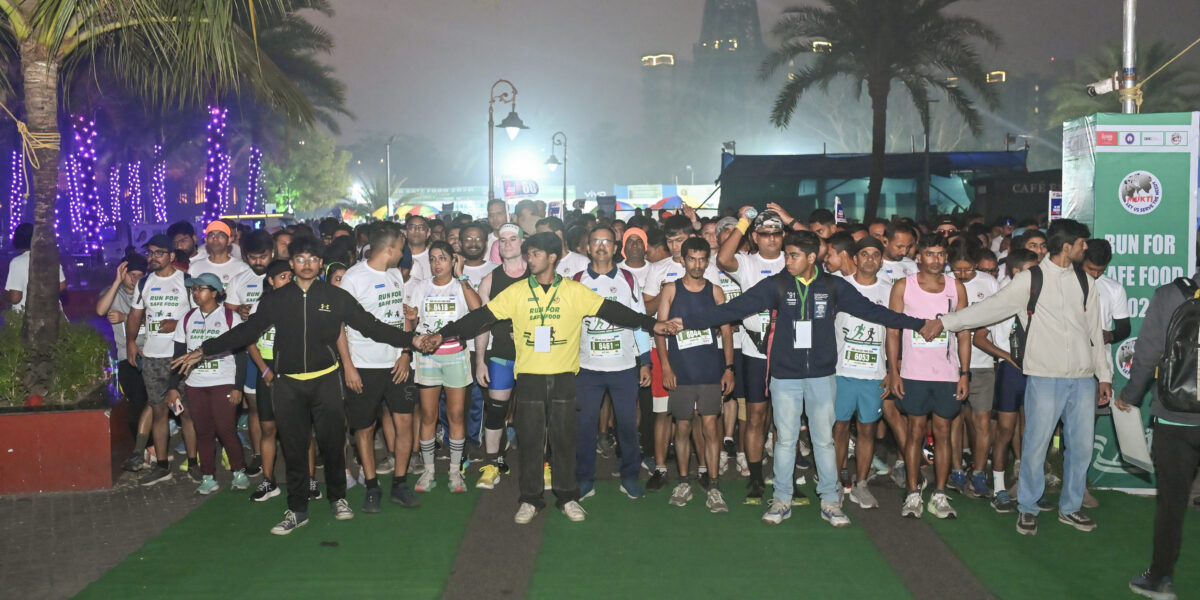
I don’t think I will ever forget that morning. As the sun started rising and Kolkata was slowly waking up, around 900 to 1,000 people eventually gathered around Organic Haat with a wonderful energy. It felt as if something new was happening. People had come for themselves, for friends and family, for farmers and for the generation that will follow us. Antara did a marvellous job energising everyone through Zumba and her way of engaging the runners. Newtown Runners executed the actual run beautifully — from route reconnaissance to the finish and medal distribution. One image from that morning still stays with me: little children standing there, helping distribute medals and greeting runners. We had specifically requested people to bring their children. Because if this was about the future, children should not remain outside the movement. As parents, that is our responsibility.
Why Serve Junk Food after a Run for Health?
We also had one very simple thought: if we are talking all morning about health and food, what should we serve after the run? Packaged snacks? Junk food? It did not feel right. So we served fresh hot khichuri made with organic rice, dal and vegetables, with traditional Bengali ghee. There was no restriction on how many servings someone could take. People loved it. Again social media was full of something rather unusual for a marathon — the khichuri. And that was exactly the point. After the run, the conversation was not only, ‘What was your timing?’ It was also, ‘What did we eat?’ and maybe even, ‘Where did it come from?’
We hardly had any sponsors that first year. One renowned mobile-phone company understood the initiative and willingly came forward, and I am still thankful to them. Financially, it was a loss-making event for MUKTI. But money was never the intention. Our return was elsewhere. People talked about organic food. They met farmers. Children saw something different. People ate healthy food together. Awareness travelled a distance. On 19 January 2025, I felt Kolkata had experienced a different kind of running event first times. Somewhere during that morning, for me, it stopped being just a run. It had started becoming a movement.
Then Came the Question: What Next?
Starting small is one thing. What do you do after that? Someone once said something to the effect that where you are born is not your choice, but where your life ultimately takes you depends greatly on what you choose to do with it. I have learnt one thing in my life: Dream big. Perhaps it has been inside me since childhood. When I compare the atmosphere in which I grew up, the time in which I grew up, the opportunities around me then, and where I am today, sometimes even I find the journey difficult to explain. Some of the dreams I saw as a child—travelling around the world, leading, doing things differently, have, to some extent, become reality. I say this with no pride in myself. Because I know very clearly that I didn’t make this journey alone. What I am today is the result of countless sacrifices and contributions by people around me, some known to me and perhaps many unknown. That feeling has always stayed with me. And strangely, it later became central to the philosophy of our second Run for Safe Food. None of us really runs through life alone.
I Did Not Want another Marathon
After the success of 2025, the obvious thing would have been to organise the same event again, perhaps with more participants. But that didn’t excite me. I wasn’t interested in adding another marathon to Kolkata’s running calendar. I was constantly thinking: How can the structure of the marathon itself communicate the message we want to spread? Then I remembered my days in Denmark. During the years when I used to be in Denmark, initially in Copenhagen and later in Aarhus, I had experienced a very interesting relay marathon. One team, five members. Each person runs 5 kilometres. At the end of 5 kilometres, the runner passes a baton to the next team member. Companies and organisations send multiple teams. Everyone sits together, cheers together, eats together and enjoys the day. What stayed with me was that it was not mainly about medals, T-shirts or personal timing. Thousands came because it was about togetherness. I thought: this format fits our cause almost perfectly. I may be wrong, but as per my knowledge in India this type relay-inspired run is not taking place today, except Run for Safe Food. Inspired by this format, I decided to start this type of run in Kolkata with slight variations. Every part of this relay-inspired run carries a deep significance.
The Baton
To me, the baton was never just a piece of relay equipment. It symbolised awareness and responsibility. One person receives it, carries it for some distance & time and then passes it to another. Isn’t that exactly what we need to do with awareness about safe food? I learn something and tell my friend. A parent tells a child. A teacher tells a student. One family influences another. One generation passes something to the next. The baton became, for me, the responsibility we pass forward.
The Team
Then there is the team. Any meaningful change needs people to come together. We cannot really live only for ourselves. Just imagine waking up one morning and discovering that there is nobody else in the world. For the first few moments maybe it sounds exciting — no traffic, no queues, no rules, everything open. But very soon it would become miserable. We are social beings. We need one another. The consumer needs the farmer. The farmer needs the consumer. The child needs the parent. The individual needs society. So if we are talking about change, it cannot be only an individual journey. That is why the team matters.
The Team Leader became the Change Leader
Our registration process gave the team leader another meaning for me. One person comes forward, creates the team and enters the details of four others. Technically that person is just the Team Leader. But I see that person as a Change Leader. He or she heard or generated an idea, believed in it, spoke to four other people and brought them together. That is how movements often grow in real life. One person convinces four. Those four influence others. Five becomes fifty, fifty becomes five hundred. Slowly an idea becomes behaviour. That was the deeper thought behind our relay-inspired Run.
Almost Nobody Believed Me
There was one complication: hardly anybody seemed as excited about the relay as I was. I explained it to old friends from Newtown Runners, experienced race organisers, timing-chip companies and administrators of large running communities. Nobody exactly discouraged me, but initially very few came forward either. Some people who had strongly supported the initial 2025 Run told me, quite sensibly, ‘Go ahead, but keep a contingency plan in case it fails.’ I took that advice. We kept the new 5×5K relay, but also decided to have the more familiar categories — a timed 10K, a 5K that later became timed following suggestions from Kolkata runners, and a 3K Walkathon. If the relay didn’t get enough response, the traditional categories would protect the event. But there was another, more important reason, which was Inclusion. If this was truly a movement, nobody should feel that it wasn’t meant for them. A serious runner could run 10K. Someone beginning the journey could do 5K. Families, senior participants and people who simply wanted to support the cause could walk 3K. Teams could take up the 5×5K relay. Different people, different distances with one purpose.
Almost Two Months, there was One Team only
At first, registration opened only for the 5×5K relay. I still remember looking at the number: one team. There were a few verbal commitments, but almost nothing else. Days passed, then weeks. It stayed like that for nearly two months. At one point I genuinely thought maybe we would have to scrap the idea. Maybe people of Kolkata were not ready for it. But somehow I still believed it could work, so I kept preparing quietly. Then we opened the other three categories. Registrations started moving slowly — one today, four tomorrow, five another day. We were still far away from our target of around 1,500 runners. Then another person entered the story.
Ravi Ranjan and the Kolkata Running Community
I knew Kolkata had many running groups, but apart from Newtown Runners I did not really know them personally. Then I got connected with Ravi Ranjan. I knew him only distantly as someone who encouraged runners across Kolkata and tried to bring running groups together. Ravi suggested that instead of explaining the idea one by one, we should meet the administrators of the running groups and explain the cause directly. He helped with few contacts. We arranged one physical meeting and one virtual meeting. Honestly, that changed the game. People began to understand what we were trying to do. Many came forward and helped. Two people deserve special mention from me — Souvik and Dilip. They supported the initiative willingly and unconditionally. I remain thankful to both of them for believing the idea and also trusting me. Then came Sayan. I should admit this honestly: initially I was a little unsure about his capability and dedication. I was wrong. His dedication proved me wrong completely. The way he set up and handled the technical side of the run was amazing. Slowly I felt that Souvik, Sayan, Dilip and I had become four pillars holding a large part of the Run together. From there, things started moving.
Finding a Home for the Relay
There was one route in Kolkata that I had always loved as a runner — inside the Eco Park, alongside the lake and through the stretches with trees on both sides. But for the relay we needed much more than a nice route. We needed a large space where teams from companies, schools, colleges, residential complexes and other organisations could sit together in their own tents. I wanted part of the relay route to pass near those tents so teammates could cheer their runner. We also needed space for the expo on the previous day, for a model village and agricultural displays, for seminars and discussions on sustainable agriculture, for farmers, food and culture. In short, we were trying to create much more than a start and finish line – Organic food, education & awareness, cultural fest. Initially, we considered a large green field inside Eco Park near gate 1, but the cost was beyond what we could afford. So we scaled the plan differently. Finally we selected the field beside the Eiffel Tower replica within Eco Park, with the beautiful lake beside it. We booked the venue for 14 and 15 February 2026. The idea finally had a home.
From One Team to 1,500 Runners
With help coming from many directions, registrations kept growing and finally we reached around 1,500 runners, including 20 relay teams. The second edition of this Run for Safe Food was set for 15 February 2026 at Eco Park, Kolkata. By then Run for Safe Food was clearly becoming more than a conventional race — it was about safe and organic food, conscious living, farmers and collective responsibility. But of course, no big event becomes a big event without some problem somewhere. This time another one was waiting for us.
This Time it wasn’t the Medal
We had learnt from 2025, so this time the medals were not the problem. The T-shirts were. The vendor had been given enough time and had been repeatedly told about our distribution plan, but somehow he seemed to think that because the run was on the 15th, delivery on the night of the 14th should still be fine. It was not fine. There were tense moments again. MUKTI colleagues once again worked day and night. They were not professional marathon organisers; they were people trying to make something work because they cared about it. With some internal hiccups, and thankfully very little impact on runners, we managed. Another lesson learnt. That is one thing I have come to value in this journey — every edition teaches us something.
India Taught Me something about My Own Idea
We had planned the relay carefully, but we still faced some issues in conducting it and our run organizing team handled those issues very well. I also learnt something about my own idea. My understanding of relay running came from what I had seen in Europe, where these events were often quite social and not strongly competitive. I imagined the same here. But in the Indian running context, competition is difficult to remove. Runners want timing. They want results. They want to know who came first. At first I wondered whether that went against what I had imagined. Later I realised maybe it does not have to. We do not need to remove competition. We need to make the cause bigger than the competition. Run fast, improve your timing, compete, celebrate your achievement — but when you receive the baton, remember what else it stands for.
And when you finish, remember why thousands of us came together. Slowly, runners seemed to understand the difference we were trying to bring. And the feedback told us something important: People had enjoyed running for a cause, not only running against one another.
15 February 2026
Then came the morning of 15 February 2026. Antara once again did a tremendous job, keeping the programme moving, bringing energy and using her Zumba skills to keep everyone warm and involved. A renowned film personality also came to cheer the runners and pay tribute to the farmers. But when I remember that morning now, the things that come first to my mind are not the formal moments. They are the smaller scenes — participants meeting farmers, people taking selfies with them, those photos going to social media, someone telling a farmer, ‘Please come again next year,’ and somebody else saying, ‘We should meet you more often.’ That mattered to me, because suddenly the person behind our food had a face.
Vegetables Again. Khichuri Again. Theme Song.
Of course, we could not leave behind what had already become part of our identity. Once again, participants received more than a kilogram of fresh organic vegetables in their goody bags. All over places Run for Safe Food theme song was playing. It was so vibrant and energetic, it added another uniqueness to our Run. Thanks to Amit for making the theme song. After the run came our other signature item — fresh hot organic khichuri. I still have one picture in my mind from that morning. Thousands of people after running, a Kolkata winter morning, hot khichuri, people sitting and standing together, the lake beside us, the sun rising above it and its light reflecting on the still water and then spreading to all possible directions carrying the message & intent of supporting those farmers producing poison-free food for us. Farmers and urban consumers in the same place. In that moment I felt the philosophy of Run for Safe Food was visible without anyone having to explain it. Urban life had met agriculture. Running had met responsibility. The earlier concept behind the event had always imagined a broader gathering around organic farmers, safe food, awareness, culture and collective participation rather than merely a race. That morning, I could see it happening.
Perhaps Life Itself Is a Relay
While writing this, I realise that the relay has become more personal to me than I first understood. I spoke earlier about my own journey. Whatever I am today is not something I created alone. People gave me opportunities. People sacrificed. People taught me. People trusted me. Some challenged me. Some stood beside me when an idea looked foolish. Some came forward when others did not. Some probably solved problems that I never even came to know about. In one way or another, they passed something to me and I carried it. Perhaps life itself is a relay. We receive something from those before us, carry it for some distance, and then one day it becomes our turn to pass it on. Our parents passed something to us. Our teachers passed something to us. Society passed something to us.
Farmers whom we may never meet are also passing something to us every day through the food on our tables, their unconditional love to us. Nature has passed to us soil, water, forests and biodiversity built over periods of time we can hardly imagine. Now the baton is in our hands. We will pass it one day, whether we think about it or not. Our generation will move on and the next will take over. So the real question is not whether we will pass the baton. The question is: in what condition will we pass it? Will the soil still be fertile? Will water still be safe? Will farmers still find dignity in farming? Will our children know what real food tastes like? Will they know where a pea comes from? Will they recognise a jamrul? Will they ever sit under a mango tree and eat the mango that grew above their heads? Will farming remain a livelihood someone can practise with dignity? Will our children inherit merely greater economic wealth, or will they inherit a healthier world in which to enjoy that wealth? These questions are much bigger than a marathon. And that is exactly why Run for Safe Food is not just a marathon.
Now, the Third Edition
I am writing this in August 2026. The date for the third edition has now been finalised — 14 February 2027. Early-bird registration will soon begin. There is excitement, planning and of course targets. But before thinking about any of that, I want to say something much simpler: thank you. Thank you to everyone who supported me in these last two years. Some of you I know very well. Some only a little. And many I probably do not know at all. Some ran, some volunteered, some worked through the night, some handled registrations, bibs, runners or medals, some cooked, some brought vegetables, some stood beside farmers, some helped financially, some gave advice and some criticized us, and even those criticisms helped us improve. Some simply shared a social-media post or told a friend, ‘You should join this’. Maybe somewhere someone heard our message and thought a little differently the next time they bought organic vegetables for the family. If that happened, that also matters. To every one of you, thank you. None of this belongs to one person. It does not belong only to me and it does not belong only to MUKTI. We are connected by one common thread — hope. Hope for a better future, healthier families, farmers, living soil, food that nourishes, and a better place for the next generation.
2027 — Bigger, but Not Just in Numbers
For the third edition, we are not planning to change the basic format. We want to scale it up and take the movement to more people. The 5×5K Relay will continue, along with the 10K timed run, 5K timed run and 3K Walkathon. But for me, scaling up does not only mean a bigger registration number. I want us to reach more schools, colleges, companies, institutions, residential communities, families, children and young people across Kolkata. I want the event to feel like a family gathering around a cause — run, walk, learn, eat together, laugh, meet farmers, ask questions, celebrate and go home carrying something more than a medal. The second edition showed us what this larger ecosystem could look like. Now we want to strengthen it.
Bring the Next Generation
If there is one area where I particularly want us to do more in 2027, it is involving the next generation. Bring your children. Please. Do not think, ‘He is too young’ or ‘She does not run.’ They do not have to run. Let them come. Let them meet a farmer, touch soil, understand how rice grows and discover that vegetables do not begin their life inside a supermarket. Let them ask questions. Let them understand why sustainable agriculture matters. We want to bring more educational elements into the event. If a child goes home and asks, ‘Where did this vegetable come from?’ that is success. If another says, ‘Can we visit a farm?’ that is success. If a child sees a farmer and understands that this person plays an essential role in his or her life: That is success. Perhaps much more than a medal.
The Movement must also become Sustainable
There is also one practical goal this year. The first two Runs required financial support from MUKTI. We did not create Run for Safe Food to make money and we still do not see it that way. But if we truly believe in sustainability, the initiative itself should also learn to sustain itself. So this year we will try to move closer to a cost break-even position — not to generate profit, but so that the Run can stand on its own feet and return year after year without continuously drawing resources away from MUKTI’s other development work. I think that is also part of our learning. Sustainability cannot be something we preach only to farmers; our own initiative must try to practise it too.
Finally, I Pass the Baton to You
When I started writing this story, I was thinking about farmers. Then came Aila, the soil, organic farming, our changing food habits, our children, that slightly crazy decision in December 2024 to organise a marathon with barely more than a month in hand, one sleepless night correcting payment records, medals stuck between Delhi and Kolkata, vegetables inside marathon goody bags, hot khichuri, 500 registrations, then one lonely relay team, weeks of wondering whether the idea would fail, people who eventually believed, 20 relay teams, around 1,500 runners, Eco Park, the lake, the rising sun, farmers taking selfies with urban consumers — and now 2027. When I look at all of it together, I feel these are not separate stories. They are connected by one baton, the baton we must pass.
The farmer passes food to us. Nature passes its resources to us. Our elders pass knowledge to us. Other people pass opportunities to us. We receive, we carry, and then we give. So on 14 February 2027, I do not want to invite you simply to join another marathon. I want to invite you to become part of this movement. Come with your family. Bring your children and friends. Form a team. Bring your colleagues, school, college or residential community. Run 10K, run 5K, walk 3K, or take the baton with four others in the 5×5K relay. The distance does not matter as much as the reason you are there. Meet a farmer. Thank them. Think about what you eat and where it came from. Think about the soil. Think about your children. And when you understand something, however small, tell somebody else.
Pass it forward. Because I do not believe change always begins with some very powerful person somewhere. It can begin with us — one conversation, one family, one food choice, one farmer we decide to support, one child we take to a field, one person we inspire, one step, and perhaps one baton passed from one hand to another. Come forward. Inspire others. Be part of the change. Change starts from you. And when our time comes to hand the baton to the generation after us, I hope we can look at them and say, honestly, that we tried to leave it better than we received it. That, to me, is Run for Safe Food. Not just a run. A movement for farmers, our families, our soil, our children and a healthier, more sustainable future.
Be healthy. Choice is ours!
With gratitude,
Satyajit Roy
Run Director, Run for Safe Food
Secretary, MUKTI
Project Activities
- A village for independent and enterprising women (A VIEW) (5)
- About Mukti (11)
- Accreditation (14)
- AGM (63)
- Agriculture Reforms (130)
- Ambulance Service (2)
- Amplifying Community Voices (77)
- Awards (17)
- Awareness and Empowerment (141)
- Awareness drives (64)
- Bio-Village-Kankandighi (10)
- Careers (10)
- Chick Rearing Programme for Marginalised Women (17)
- CHILD (25)
- Climate Resilience River Embankment (46)
- Covid-19 (74)
- Cultural Shows (7)
- Cyclone Aila (13)
- Cyclone Amphan (44)
- Cyclone Bulbul (30)
- Cyclone Dana (3)
- Cyclone Remal (12)
- Cyclone Response & Recovery (90)
- Cyclone Tolerant Houses (15)
- Cyclone Yaas (57)
- Daily Activities USA (25)
- Disaster Recovery (265)
- Editorial (73)
- Editorial by Abir Biswas (1)
- Editorial by Amit Kumar Dey (4)
- Editorial by Ananya Chatterjee (3)
- Editorial by Ankita Kothiyal (5)
- Editorial by Chandrachur Chatterjee (1)
- Editorial by Debabrata Halder (2)
- Editorial by Dr. Alokananda Ghosh Sengupta (2)
- Editorial by Kasturi Bakshi (1)
- Editorial by Monami Mitra (1)
- Editorial by Nandita (4)
- Editorial by Pampa Karmakar (1)
- Editorial by Paramita Panja (1)
- Editorial by Pranay Patra (1)
- Editorial by Prof. Pradeep Ray (1)
- Editorial by Ranitendranath Tagore (2)
- Editorial by Sankar Halder (16)
- Editorial by Satyajit Ray (11)
- Editorial by Sohini Mehta (1)
- Editorial by Sonamon Basu (3)
- Editorial by Soumitra Bose (4)
- Editorial by Subhankar Basu (1)
- Editorial by Supriya Sarkar (1)
- Editorial by Supriyo Banerjee (4)
- Editorial by Ujjwal Maity (2)
- Education and Enrichment (471)
- Environment and Resilience (132)
- Featured Activities (32)
- Gram Clinic (9)
- Health Water & Sanitation (103)
- HOPE (10)
- Impact Stories List (109)
- Integrated Development (247)
- International Management Institute (IMI) (2)
- Jal hi Kal (6)
- KF Mukti Clinic (2)
- Kitchen Gardening (16)
- Livelihood & Enablement (241)
- MCDF (122)
- Medical Camp (48)
- MIT (8)
- MKSS (62)
- MSS (161)
- Mukti Academia (5)
- Mukti Academy (2)
- Mukti BSI Digital Herberium (1)
- Mukti Craft (18)
- Mukti Cultural (2)
- Mukti Employment Exchange (MEE) (29)
- Mukti Fresh (15)
- Mukti Gram - Egra (12)
- Mukti Gram - Purbashridharpur (172)
- Mukti Green Defense in Sundarbans (12)
- Mukti URBAN (18)
- Mukti USA (2)
- Mukti Yoga (12)
- Mukto Dhara (2)
- Navya (3)
- NIRMAN (5)
- Northumbria University (2)
- Obituary (6)
- Observance Days Celebration (54)
- Organic Farming & Training Support (49)
- Pond Rejuvenation (21)
- Prerana (5)
- Projects For Mukti Wide (7)
- Queen Mary University of London (1)
- Rights and Special Needs (132)
- Run for Cause (16)
- Run4SafeFood (11)
- SDF (6)
- Shahoshini (15)
- Skill & Enterprise Development (21)
- Smart lab (5)
- Social Stock Exchange (2)
- Social Workers' Convention (1)
- Sundarbans Green (SUN-G) (15)
- Sunderban development fair project (4)
- Suraksha Songlap (3)
- Surya (28)
- Sustainable Agriculture Movement (67)
- SWAS-2-0 (23)
- Swastha Shongini (33)
- Swavalamban Accelerator in Sundarbans (SWAS) (22)
- Tour for Cause (52)
- TSS (222)
- UDAAN (9)
- Uncategorized (109)
- University of Calcutta (2)
- Value Education (13)
- Valued Partners (3)
- Vocational Trainings (15)
- VOICE (15)
- Voice Sunderban (2)