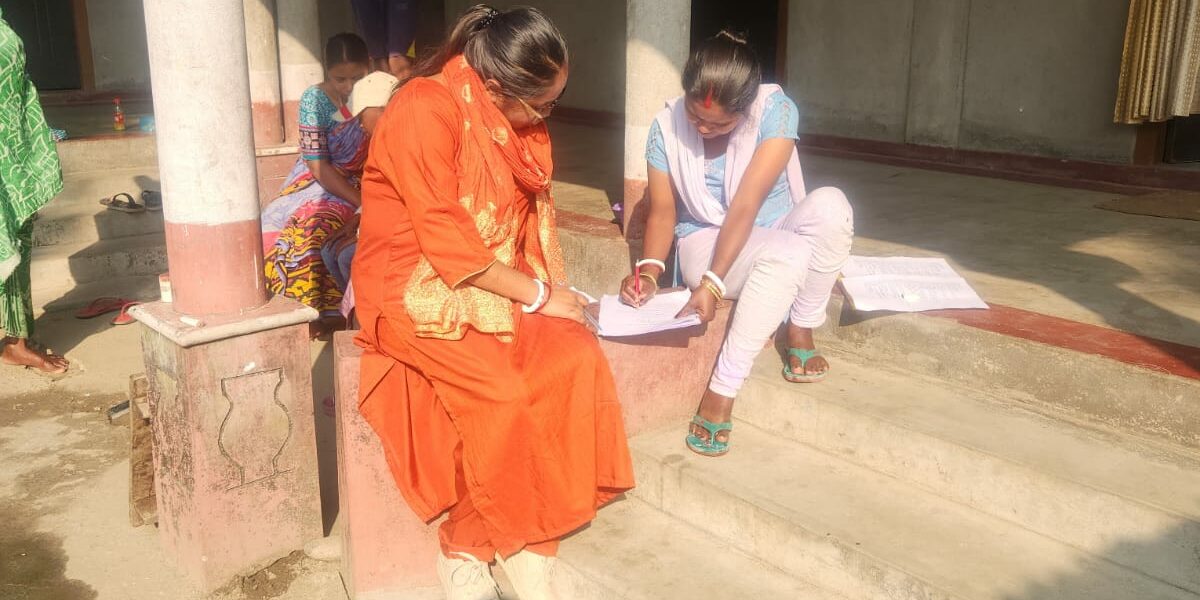
Project NIRMAN: MUKTI Initiates Household-Level Need Assessment in Lataguri
MUKTI has initiated a household-level need assessment under Project NIRMAN in the Lataguri project area as part of its ongoing commitment to participatory and context-responsive development practice. The exercise builds upon MUKTI’s long-standing engagement with the community and seeks to strengthen programme planning through deeper understanding of lived realities and emerging local priorities.
Unlike conventional assessments designed as one-time diagnostic exercises, the current initiative is being carried out as a reflective and iterative process. It draws from existing relationships, trust, and continuous field engagement, allowing the assessment to evolve alongside community interactions rather than remaining a static data-collection activity.
The assessment is being conducted through systematic house-to-house visits across the project area. Field teams are engaging directly with households to understand everyday challenges, coping mechanisms, and aspirations. Information is being gathered through informal interviews, field observations, and focused discussions with different community groups, including women, youth, and elders. This approach allows community members to articulate their concerns and priorities in their own voices, within familiar and comfortable settings.
Emphasis has been placed on dialogue and ethical engagement rather than extractive data collection. Conversations are being facilitated in a manner that encourages openness and mutual learning, reinforcing trust between the community and field teams. The process recognises that meaningful insights emerge not only from responses to questions, but also from careful observation, listening, and sustained interaction.
Field animators, supported by the entire Lataguri field team, are playing a central role in carrying out the assessment. Field facilitators are providing guidance to ensure cultural appropriateness, inclusivity, and effective communication throughout the process. Special attention is being given to ensuring that voices often marginalised in formal consultations—particularly women and young people—are actively included.
The ongoing assessment is expected to generate grounded insights that will directly inform programme strategies and implementation approaches under Project NIRMAN. The findings will help identify gaps, refine interventions, and strengthen community mobilisation efforts, while also contributing to evidence-based proposal development for future initiatives.
At its core, the need assessment reflects MUKTI’s rights-based and participatory approach to development. Community members are not viewed merely as beneficiaries, but as key stakeholders whose perspectives and experiences are essential in shaping responsive and sustainable interventions. By embedding assessment within everyday field engagement, MUKTI aims to ensure that development planning remains rooted in local realities and guided by community priorities.
The process will continue in the coming weeks, with learning and reflection informing subsequent phases of programme design and action. Through this approach, Project NIRMAN seeks to reinforce community ownership and strengthen the foundation for collective and contextually relevant development efforts.
Project Activities
- A village for independent and enterprising women (A VIEW) (5)
- About Mukti (4)
- Accreditation (14)
- AGM (63)
- Agriculture Reforms (124)
- Ambulance Service (2)
- Amplifying Community Voices (67)
- Awards (15)
- Awareness and Empowerment (137)
- Awareness drives (61)
- Bio-Village-Kankandighi (10)
- Careers (14)
- Chick Rearing Programme for Marginalised Women (16)
- CHILD (23)
- Climate Resilience River Embankment (46)
- Covid-19 (74)
- Cultural Shows (7)
- Cyclone Aila (13)
- Cyclone Amphan (44)
- Cyclone Bulbul (30)
- Cyclone Dana (3)
- Cyclone Remal (12)
- Cyclone Response & Recovery (90)
- Cyclone Tolerant Houses (15)
- Cyclone Yaas (57)
- Disaster Recovery (264)
- Editorial (58)
- Editorial by Abir Biswas (1)
- Editorial by Amit Kumar Dey (3)
- Editorial by Ananya Chatterjee (3)
- Editorial by Ankita Kothiyal (4)
- Editorial by Debabrata Halder (1)
- Editorial by Dr. Alokananda Ghosh Sengupta (2)
- Editorial by Kasturi Bakshi (1)
- Editorial by Monami Mitra (1)
- Editorial by Nandita (3)
- Editorial by Pampa Karmakar (1)
- Editorial by Pranay Patra (1)
- Editorial by Prof. Pradeep Ray (1)
- Editorial by Ranitendranath Tagore (1)
- Editorial by Sankar Halder (14)
- Editorial by Satyajit Ray (7)
- Editorial by Sohini Mehta (1)
- Editorial by Sonamon Basu (3)
- Editorial by Soumitra Bose (2)
- Editorial by Subhankar Basu (1)
- Editorial by Supriya Sarkar (1)
- Editorial by Supriyo Banerjee (3)
- Editorial by Ujjwal Maity (2)
- Education and Enrichment (422)
- Environment and Resilience (127)
- Featured Activities (24)
- Gram Clinic (9)
- Health Water & Sanitation (97)
- HOPE (10)
- Impact Stories List (109)
- Integrated Development (219)
- International Management Institute (IMI) (2)
- Jal hi Kal (6)
- Kitchen Gardening (16)
- Livelihood & Enablement (220)
- MCDF (119)
- Medical Camp (45)
- MIT (8)
- MKSS (50)
- MSS (147)
- Mukti Academia (5)
- Mukti Academy (2)
- Mukti Craft (18)
- Mukti Cultural (2)
- Mukti Employment Exchange (MEE) (9)
- Mukti Fresh (15)
- Mukti Gram - Egra (11)
- Mukti Gram - Purbashridharpur (170)
- Mukti Green Defense in Sundarbans (11)
- Mukti Yoga (12)
- Mukto Dhara (2)
- Northumbria University (2)
- Obituary (6)
- Observance Days Celebration (53)
- Organic Farming & Training Support (45)
- Pond Rejuvenation (20)
- Prerana (1)
- Prerna (4)
- Projects For Mukti Wide (7)
- Queen Mary University of London (1)
- Rights and Special Needs (113)
- Run for Cause (13)
- Run4SafeFood (7)
- SDF (6)
- Shahoshini (9)
- Skill & Enterprise Development (21)
- Smart lab (5)
- Social Stock Exchange (2)
- Social Workers' Convention (1)
- Sundarbans Green (SUN-G) (15)
- Sunderban development fair project (4)
- Surya (13)
- Sustainable Agriculture Movement (63)
- SWAS-2-0 (19)
- Swastha Shongini (33)
- Swavalamban Accelerator in Sundarbans (SWAS) (21)
- Tour for Cause (45)
- TSS (201)
- UDAAN (8)
- Uncategorized (99)
- University of Calcutta (1)
- Value Education (12)
- Valued Partners (3)
- Vocational Trainings (15)
- VOICE (14)