Our Choices. Their Future.
The recent flash flood in the Nepal–Tibet Himalayan region is difficult to look at simply as another piece of news. People lost their lives. Families lost loved ones. Communities that had lived beside those mountains and rivers for generations suddenly found themselves facing an enormous force of water, ice, rock and debris.
High in the Himalayas, a huge section of glacier and rock collapsed and rushed down into the river system below. Scientists will continue to study exactly what triggered this particular collapse. But we also know that the Himalayan cryosphere is changing. Glaciers are losing mass, snow and ice patterns are changing, and scientists are increasingly concerned about the risks that come with a warming mountain environment.
For me, there is a very human question behind all this: What kind of Earth are we going to leave for our children?
It is an uncomfortable question because the answer is not only somewhere in the Himalayas. It is also in our homes. It is in what we eat, what we waste, what we buy, how much we consume, how we use water and natural resources, and what we teach our children through the way we live.
Think about something as ordinary as a plate of vegetables on our dining table. We usually see the vegetables. We don’t see the chain behind them. There is a farmer. There is soil. There is water. There are seeds, insects, rainfall, seasons and years of knowledge. If the soil becomes unhealthy, water becomes stressed, farming becomes increasingly chemical-dependent or weather becomes unpredictable, the effect does not remain in the field.
Sooner or later, it reaches our plate. That simple connection is at the heart of MUKTI Run for Safe Food. Healthy people need healthy food. Healthy food needs healthy farming. Healthy farming needs a healthy planet. And the planet we shape today is the one our children will live on tomorrow.
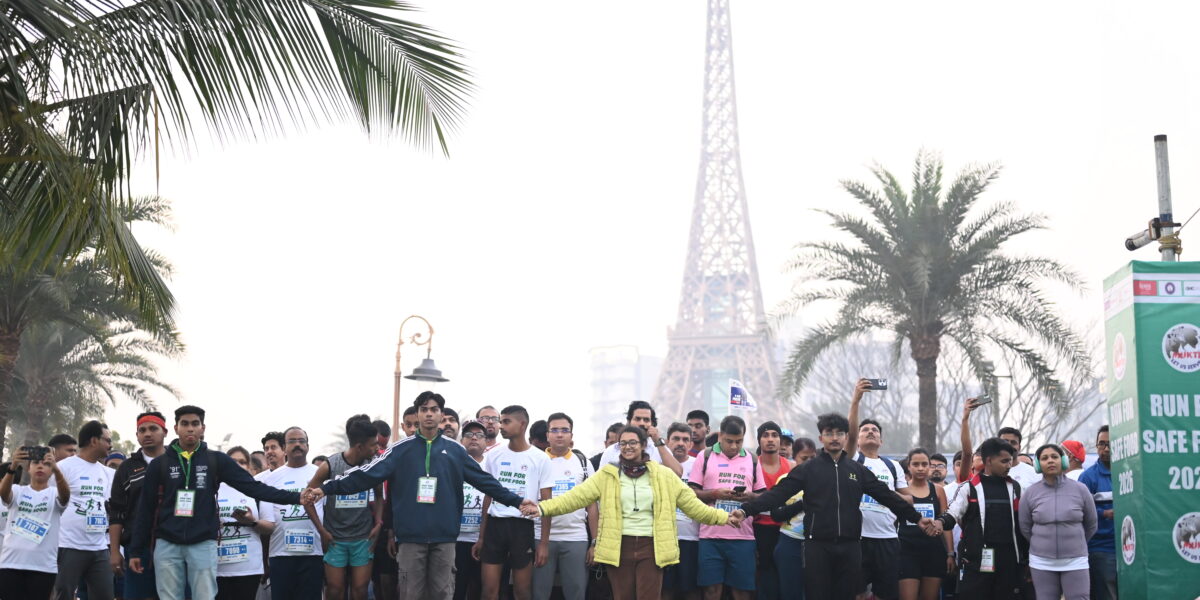
This is why we run. Not because running 5 or 10 kilometres will solve climate change. It won’t. We run because we want to build awareness. We want you to think about where your food comes from. We want children to know that a tomato does not begin in a supermarket. We want families to talk about healthier food choices. We want consumers to value farmers who are trying to farm responsibly. And we want more of us to understand that our everyday choices have consequences beyond our own lives.
These may seem like small things. They are. But small does not mean unimportant. A child who learns to respect food may waste less of it. A family that starts asking where its food comes from may begin making different choices. More conscious consumers can encourage more responsible production. One conversation can lead to another.
Awareness is often where responsibility begins. And this brings us to the baton. In our 5×5K Team Relay, one person runs five kilometres and hands the baton to the next. That person carries it for a while and passes it again. Life is not very different. We inherit food from farmers, resources from nature, knowledge from our elders and opportunities from society. None of these truly belongs to us forever. We hold them for some time. Then we pass them on.
The events in the Himalayas make that thought much more real. Things in nature that we grew up believing were enormous, distant and almost permanent can also become vulnerable. Our grandparents passed a world to our parents. Our parents passed one to us. And whether we think about it or not, we are already preparing the world that our children will receive from us.
So the question is not whether we will pass the baton. We certainly will. The question is: in what condition will we pass it? What kind of soil will they inherit? What kind of water? What kind of farms, forests, rivers and mountains? And perhaps just as importantly, what kind of habits will they inherit from us? None of us can stand in Kolkata and protect a Himalayan glacier with our own hands. We cannot solve a changing climate through one decision.
But we can be more thoughtful about how we live. We can make better choices where we can. We can respect the farmer behind our food. We can waste less. We can help our children understand their connection with nature. We can talk about these things with another family, another friend, another colleague. And we can refuse to believe that because our individual action is small, it does not matter.
That is the awareness we want Run for Safe Food to carry from one person to another. One person. One family. One team. One baton at a time. Because the baton is already in our hands. What matters now is the condition in which we pass it forward.
With Gratitude,
Satyajit Roy
Run Director, Run for Safe Food
Secretary, MUKTI
Project Activities
- A village for independent and enterprising women (A VIEW) (5)
- About Mukti (11)
- Accreditation (14)
- AGM (63)
- Agriculture Reforms (130)
- Ambulance Service (2)
- Amplifying Community Voices (77)
- Awards (17)
- Awareness and Empowerment (141)
- Awareness drives (64)
- Bio-Village-Kankandighi (10)
- Careers (10)
- Chick Rearing Programme for Marginalised Women (17)
- CHILD (25)
- Climate Resilience River Embankment (46)
- Covid-19 (74)
- Cultural Shows (7)
- Cyclone Aila (13)
- Cyclone Amphan (44)
- Cyclone Bulbul (30)
- Cyclone Dana (3)
- Cyclone Remal (12)
- Cyclone Response & Recovery (90)
- Cyclone Tolerant Houses (15)
- Cyclone Yaas (57)
- Daily Activities USA (25)
- Disaster Recovery (265)
- Editorial (73)
- Editorial by Abir Biswas (1)
- Editorial by Amit Kumar Dey (4)
- Editorial by Ananya Chatterjee (3)
- Editorial by Ankita Kothiyal (5)
- Editorial by Chandrachur Chatterjee (1)
- Editorial by Debabrata Halder (2)
- Editorial by Dr. Alokananda Ghosh Sengupta (2)
- Editorial by Kasturi Bakshi (1)
- Editorial by Monami Mitra (1)
- Editorial by Nandita (4)
- Editorial by Pampa Karmakar (1)
- Editorial by Paramita Panja (1)
- Editorial by Pranay Patra (1)
- Editorial by Prof. Pradeep Ray (1)
- Editorial by Ranitendranath Tagore (2)
- Editorial by Sankar Halder (16)
- Editorial by Satyajit Ray (11)
- Editorial by Sohini Mehta (1)
- Editorial by Sonamon Basu (3)
- Editorial by Soumitra Bose (4)
- Editorial by Subhankar Basu (1)
- Editorial by Supriya Sarkar (1)
- Editorial by Supriyo Banerjee (4)
- Editorial by Ujjwal Maity (2)
- Education and Enrichment (471)
- Environment and Resilience (132)
- Featured Activities (32)
- Gram Clinic (9)
- Health Water & Sanitation (103)
- HOPE (10)
- Impact Stories List (109)
- Integrated Development (247)
- International Management Institute (IMI) (2)
- Jal hi Kal (6)
- KF Mukti Clinic (2)
- Kitchen Gardening (16)
- Livelihood & Enablement (241)
- MCDF (122)
- Medical Camp (48)
- MIT (8)
- MKSS (62)
- MSS (161)
- Mukti Academia (5)
- Mukti Academy (2)
- Mukti BSI Digital Herberium (1)
- Mukti Craft (18)
- Mukti Cultural (2)
- Mukti Employment Exchange (MEE) (29)
- Mukti Fresh (15)
- Mukti Gram - Egra (12)
- Mukti Gram - Purbashridharpur (172)
- Mukti Green Defense in Sundarbans (12)
- Mukti URBAN (18)
- Mukti USA (2)
- Mukti Yoga (12)
- Mukto Dhara (2)
- Navya (3)
- NIRMAN (5)
- Northumbria University (2)
- Obituary (6)
- Observance Days Celebration (54)
- Organic Farming & Training Support (49)
- Pond Rejuvenation (21)
- Prerana (5)
- Projects For Mukti Wide (7)
- Queen Mary University of London (1)
- Rights and Special Needs (132)
- Run for Cause (16)
- Run4SafeFood (11)
- SDF (6)
- Shahoshini (15)
- Skill & Enterprise Development (21)
- Smart lab (5)
- Social Stock Exchange (2)
- Social Workers' Convention (1)
- Sundarbans Green (SUN-G) (15)
- Sunderban development fair project (4)
- Suraksha Songlap (3)
- Surya (28)
- Sustainable Agriculture Movement (67)
- SWAS-2-0 (23)
- Swastha Shongini (33)
- Swavalamban Accelerator in Sundarbans (SWAS) (22)
- Tour for Cause (52)
- TSS (222)
- UDAAN (9)
- Uncategorized (109)
- University of Calcutta (2)
- Value Education (13)
- Valued Partners (3)
- Vocational Trainings (15)
- VOICE (15)
- Voice Sunderban (2)