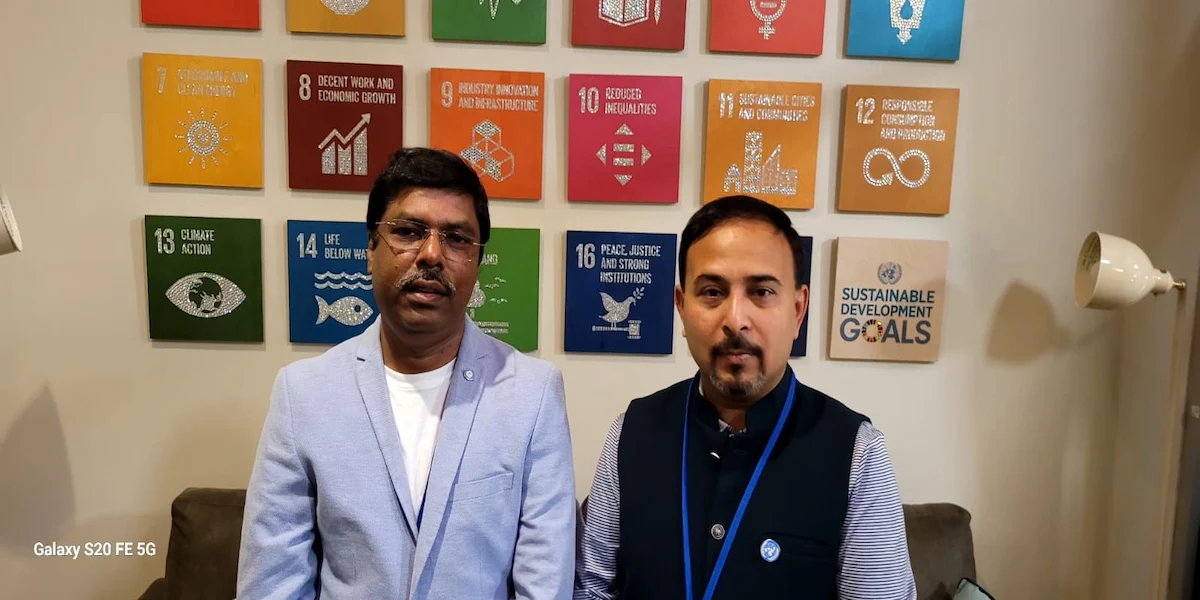
Mukti Contributes to Global Dialogue on Sustainable Development at the United Nations HLPF 2026
Mukti continued to strengthen its global engagement by actively participating in the 2026 High-level Political Forum (HLPF) on Sustainable Development, held at the United Nations Headquarters in New York from 7–16 July 2026. Representing Mukti, Sankar Halder, Founder & President, and Satyajit Roy, Secretary, participated in the Forum on 7th July, 13th July, and 14th July 2026, attending official country presentations, thematic discussions, and interactive sessions with government representatives, UN officials, development practitioners, and civil society leaders from across the world.
The participation provided Mukti with an excellent opportunity to understand how countries are accelerating the implementation of the 2030 Agenda for Sustainable Development, while also sharing grassroots experiences from India, particularly from the climate-vulnerable Sundarbans.
During the Forum, national delegations, including Senegal and Italy, presented their Voluntary National Reviews (VNRs), highlighting progress, challenges, and innovative approaches towards achieving the Sustainable Development Goals (SDGs).
Senegal showcased remarkable achievements in sustainable transport, climate action, food security, rural development, water resource management, and institutional reforms. The country highlighted significant investments in sustainable mobility, improved connectivity, environmental protection, agricultural transformation, and community-centred development. Senegal also emphasized stronger partnerships and integrated governance as essential drivers for accelerating sustainable development.
Italy focused on the importance of integrated governance, culture as a catalyst for sustainable development, youth participation, policy coherence, multi-level collaboration, and international partnerships. The Italian delegation emphasized that effective implementation of the SDGs requires stronger legal and institutional frameworks, innovation, active participation of younger generations, and coordinated action among governments, communities, and civil society.
Another participating country presented its whole-of-government approach to sustainable development, demonstrating how integrated policy frameworks, science, innovation, research, and partnerships with the United Nations are being leveraged to advance food security, healthcare, education, water and sanitation, decent work, and peace-building across partner countries.
Across all the country presentations, one message emerged consistently: achieving the Sustainable Development Goals requires integrated, people-centred, and partnership-driven approaches rather than isolated interventions. Governments increasingly recognize that sustainable development depends upon strong local institutions, climate resilience, sustainable agriculture, quality education, accessible healthcare, environmental conservation, digital innovation, gender equality, and active citizen participation.
These priorities closely resonate with Mukti’s philosophy of integrated rural development.
For more than two decades, Mukti has been implementing a comprehensive community development model across the Sundarbans and other vulnerable regions of West Bengal. Through its HEALER AID framework, Mukti addresses multiple dimensions of sustainable development, including healthcare, education, sustainable agriculture, livelihood generation, environmental resilience, disaster preparedness, women’s empowerment, human rights awareness, renewable energy, and integrated community development. Over the years, these initiatives have positively impacted more than one million people, creating resilient communities while contributing directly to several Sustainable Development Goals.
Mukti’s Sustainable Agriculture Movement promotes organic farming, climate-resilient agriculture, water conservation, soil restoration, farmer capacity building, and improved market access through initiatives such as Mukti Fresh. These efforts contribute significantly to food security, sustainable livelihoods, environmental conservation, and rural economic development—areas that featured prominently in several HLPF discussions.
Similarly, Mukti’s work in education, digital inclusion, healthcare, women-led Self Help Groups, child development, disaster risk reduction, mangrove restoration, renewable energy promotion, and community participation demonstrates how local grassroots initiatives can successfully contribute to achieving global development objectives. The organisation has also aligned its programmes with the Sustainable Development Goals, reinforcing its commitment to the 2030 Agenda.
During the sessions held on 7th, 13th, and 14th July, Mukti representatives actively interacted with delegates, UN officials, development experts, and representatives of civil society organisations from different countries. These exchanges provided valuable opportunities to share Mukti’s grassroots experiences, learn from successful international practices, and explore future collaborations in areas such as climate resilience, sustainable agriculture, integrated rural development, youth engagement, and community-led innovation.
The discussions reaffirmed Mukti’s long-held belief that sustainable development cannot be achieved through economic growth alone. True development must improve people’s quality of life, ensure access to quality education and healthcare, strengthen environmental sustainability, empower women and youth, and build resilient communities capable of facing future challenges.
Mukti is grateful for the opportunity to participate in these important global discussions and to exchange ideas with fellow delegates, government representatives, UN officials, and development practitioners from around the world. Such engagements strengthen Mukti’s resolve to continue building partnerships and bringing global knowledge to local action.
As the world works towards achieving the Sustainable Development Goals by 2030, Mukti remains committed to translating global commitments into meaningful grassroots action. The organisation firmly believes that sustainable development begins within communities and that lasting change can only be achieved through inclusive participation, innovation, strong partnerships, and collective responsibility.
Mukti’s participation in the United Nations High-level Political Forum 2026 once again reflects the organisation’s growing international engagement and its unwavering commitment to building a more resilient, equitable, and sustainable future for all.
Project Activities
- A village for independent and enterprising women (A VIEW) (5)
- About Mukti (11)
- Accreditation (14)
- AGM (63)
- Agriculture Reforms (130)
- Ambulance Service (2)
- Amplifying Community Voices (78)
- Awards (17)
- Awareness and Empowerment (141)
- Awareness drives (64)
- Bio-Village-Kankandighi (10)
- Careers (10)
- Chick Rearing Programme for Marginalised Women (17)
- CHILD (25)
- Climate Resilience River Embankment (46)
- Covid-19 (74)
- Cultural Shows (7)
- Cyclone Aila (13)
- Cyclone Amphan (44)
- Cyclone Bulbul (30)
- Cyclone Dana (3)
- Cyclone Remal (12)
- Cyclone Response & Recovery (90)
- Cyclone Tolerant Houses (15)
- Cyclone Yaas (57)
- Daily Activities USA (25)
- Disaster Recovery (265)
- Editorial (74)
- Editorial by Abir Biswas (1)
- Editorial by Amit Kumar Dey (4)
- Editorial by Ananya Chatterjee (3)
- Editorial by Ankita Kothiyal (6)
- Editorial by Chandrachur Chatterjee (1)
- Editorial by Debabrata Halder (2)
- Editorial by Dr. Alokananda Ghosh Sengupta (2)
- Editorial by Kasturi Bakshi (1)
- Editorial by Monami Mitra (1)
- Editorial by Nandita (4)
- Editorial by Pampa Karmakar (1)
- Editorial by Paramita Panja (1)
- Editorial by Pranay Patra (1)
- Editorial by Prof. Pradeep Ray (1)
- Editorial by Ranitendranath Tagore (2)
- Editorial by Sankar Halder (16)
- Editorial by Satyajit Ray (11)
- Editorial by Sohini Mehta (1)
- Editorial by Sonamon Basu (3)
- Editorial by Soumitra Bose (4)
- Editorial by Subhankar Basu (1)
- Editorial by Supriya Sarkar (1)
- Editorial by Supriyo Banerjee (4)
- Editorial by Ujjwal Maity (2)
- Education and Enrichment (474)
- Environment and Resilience (132)
- Featured Activities (33)
- Gram Clinic (9)
- Health Water & Sanitation (103)
- HOPE (10)
- Impact Stories List (109)
- Integrated Development (248)
- International Management Institute (IMI) (2)
- Jal hi Kal (6)
- KF Mukti Clinic (2)
- Kitchen Gardening (16)
- Livelihood & Enablement (243)
- MCDF (122)
- Medical Camp (48)
- MIT (8)
- MKSS (64)
- MSS (162)
- Mukti (1)
- Mukti Academia (5)
- Mukti Academy (2)
- Mukti BSI Digital Herberium (1)
- Mukti Craft (18)
- Mukti Cultural (2)
- Mukti Employment Exchange (MEE) (29)
- Mukti Fresh (15)
- Mukti Gram - Egra (12)
- Mukti Gram - Purbashridharpur (172)
- Mukti Green Defense in Sundarbans (12)
- Mukti Switzerland (1)
- Mukti URBAN (19)
- Mukti USA (2)
- Mukti Yoga (12)
- Mukto Dhara (2)
- Navya (3)
- NIRMAN (5)
- Northumbria University (2)
- Obituary (6)
- Observance Days Celebration (54)
- Organic Farming & Training Support (49)
- Pond Rejuvenation (21)
- Prerana (5)
- Projects For Mukti Wide (8)
- Queen Mary University of London (1)
- Rights and Special Needs (134)
- Run for Cause (16)
- Run4SafeFood (11)
- SDF (6)
- Shahoshini (16)
- Skill & Enterprise Development (21)
- Smart lab (5)
- Social Stock Exchange (2)
- Social Workers' Convention (1)
- Sundarbans Green (SUN-G) (15)
- Sunderban development fair project (4)
- Suraksha Songlap (4)
- Surya (29)
- Sustainable Agriculture Movement (67)
- SWAS-2-0 (24)
- Swastha Shongini (33)
- Swavalamban Accelerator in Sundarbans (SWAS) (23)
- Tour for Cause (52)
- TSS (222)
- UDAAN (9)
- Uncategorized (109)
- University of Calcutta (2)
- Value Education (13)
- Valued Partners (3)
- Vocational Trainings (15)
- VOICE (15)
- Voice Sunderban (2)