How Participatory Approach is Shaping the Future of Mukti
In 2003, in a small village of the Sundarbans, a simple act of collective effort laid the foundation of what Mukti is today. There were no grand strategies. No institutional backing. No academic frameworks guiding the process. There was only a dream – a dream of building a stronger, more conscious community.
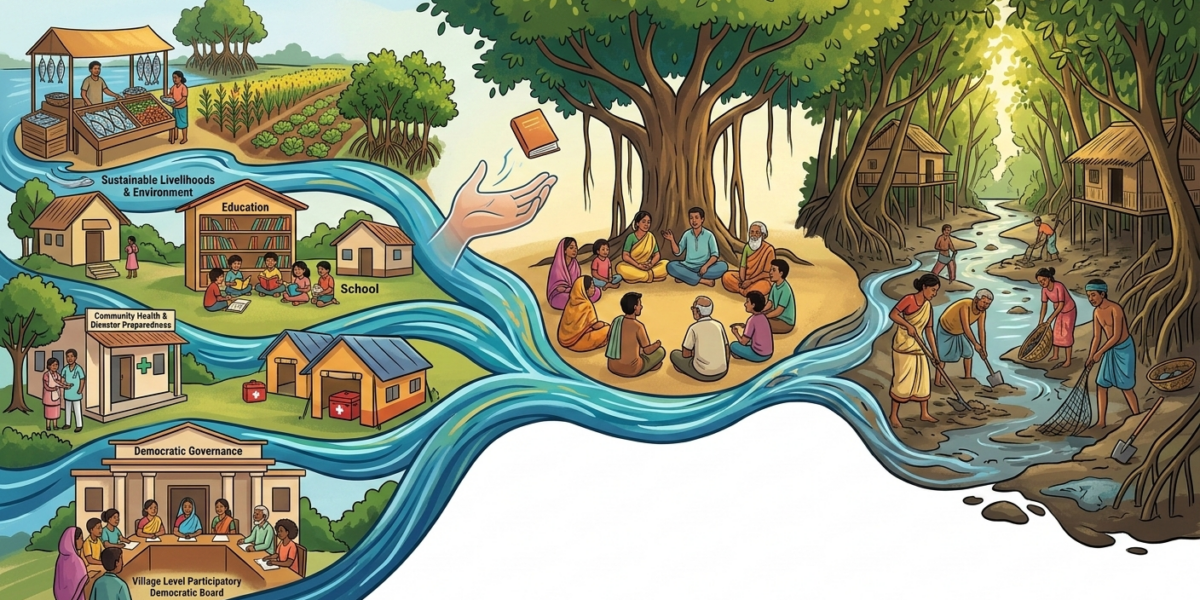
That dream belonged to Mr. Sankar Halder, who gathered a few local friends and neighbours with a proposal: to clean a neglected canal in their village. The canal had long symbolised stagnation – clogged, underutilised and forgotten. Cleaning it was not just an environmental act; it was a statement of ownership.
The community came together. The canal was cleaned. Fish extracted during the process were sold, generating a small amount of money. It was modest, but it was earned collectively. And that made all the difference. Instead of deciding alone how to utilise the funds, Shri Halder called for a village meeting. He believed that if the effort was collective, the decision must be collective as well. A participatory discussion was organised to determine how the money should be used.
The conversation was lively. Several suggestions emerged – most of them centred around renovating local temples. It was a visible, culturally valued proposal that resonated with the majority. During the discussion, a proposal came up with an alternative idea of establishing a small library for school-going children to address the growing issue of school dropouts in the village.
The suggestion did not gain traction. It was neither debated deeply nor seriously considered. The majority opinion prevailed and the funds were allocated for temple renovation.
The initiative was small. The outcome seemed straightforward. Yet the learning was transformative. That experience revealed an important truth: participation alone does not automatically ensure inclusion. Even in open discussions, existing power dynamics influence whose voices are amplified and whose are overlooked. Social hierarchies, cultural norms and intersectional identities shape collective decisions – often unconsciously.
It became clear that without conscious facilitation and an inclusive lens, participatory processes can replicate inequalities rather than challenge them. From that moment of reflection, Mukti’s deeper journey began.
From Practice to Principle
What started as a grassroots effort gradually evolved into a structured philosophy. Mukti’s early initiatives expanded from environmental action to education, health, livelihood development and disaster response in the cyclone-prone Sundarbans. With each intervention, the organisation carried forward a critical question: ‘How can development truly belong to the community?’ Participation was no longer viewed as a one-time meeting or consultation.
It became a foundational approach – a way of engaging, listening and co-creating solutions with people rather than designing programmes for them.
Over time, Mukti institutionalised this commitment by forming Village Level Participatory Democratic Boards. These platforms enabled structured dialogue, collective planning and shared accountability at the grassroots level. Decision-making became decentralised. Communities were not positioned as beneficiaries; they became partners and co-creators.
Democratic values gradually emerged as one of Mukti’s core principles. The organisation recognised that sustainable development depends not only on resources or technical inputs, but on the capacity of people to deliberate, decide and lead.
Deepening the Approach: A Transformative Shift
While Mukti’s participatory journey was grounded in lived experience, the year 2020 marked a significant turning point. The organisation began integrating academic and technical knowledge into its participatory framework.
This phase brought greater clarity about facilitation techniques, inclusive methodologies and structured tools that can minimise bias in group decision-making.
Participation evolved from instinctive practice to informed strategy. Mukti invested in understanding how conscious facilitation can ensure that marginalised voices – women, children, economically vulnerable groups and socially excluded communities – are not overshadowed in collective discussions. It embraced the understanding that inclusion requires intentional design.
This learning was not confined to training rooms. It was adopted at the senior leadership level and systematically disseminated across the organisation. Gradually, participatory principles became embedded in programme design, implementation, monitoring and evaluation. It was no longer simply about conducting discussions. It was about designing processes that create equitable spaces for dialogue.
Participation as the Foundation of the Future
Today, Mukti’s participatory approach shapes every initiative it undertakes – whether in education, health services, livelihood promotion, environmental conservation, or disaster preparedness and response.
Each intervention begins with listening. Each strategy is informed by collective analysis. Each outcome is treated as part of an ongoing learning cycle.
The organisation recognises that participatory processes are dynamic. Every discussion has the potential to challenge previous assumptions and generate better ideas. Every reflection can refine the path forward. Participation, therefore, is not static; it is iterative and evolving. The early lesson from the canal cleaning initiative continues to guide Mukti’s vision: meaningful development requires more than collective presence – it requires equitable participation. By consciously strengthening facilitation practices and nurturing democratic structures at the grassroots, Mukti is building communities that are capable of analysing their realities, identifying priorities and shaping sustainable solutions. The canal of 2003 was cleaned with simple tools and collective effort.
The Mukti of today continues that spirit – but with deeper awareness, stronger systems and a steadfast commitment to inclusive dialogue. As the organisation moves forward, it remains anchored in a powerful belief: “True transformation does not happen for a community.” It happens when the community becomes the author of its own change. And that is how participation is not only shaping Mukti’s programmes – it is shaping its future.
Nandita Jayraman
Program Manager – Rights, MUKTI
Project Activities
- A village for independent and enterprising women (A VIEW) (5)
- About Mukti (4)
- Accreditation (14)
- AGM (63)
- Agriculture Reforms (125)
- Ambulance Service (2)
- Amplifying Community Voices (67)
- Awards (15)
- Awareness and Empowerment (137)
- Awareness drives (61)
- Bio-Village-Kankandighi (10)
- Careers (14)
- Chick Rearing Programme for Marginalised Women (16)
- CHILD (25)
- Climate Resilience River Embankment (46)
- Covid-19 (74)
- Cultural Shows (7)
- Cyclone Aila (13)
- Cyclone Amphan (44)
- Cyclone Bulbul (30)
- Cyclone Dana (3)
- Cyclone Remal (12)
- Cyclone Response & Recovery (90)
- Cyclone Tolerant Houses (15)
- Cyclone Yaas (57)
- Disaster Recovery (264)
- Editorial (66)
- Editorial by Abir Biswas (1)
- Editorial by Amit Kumar Dey (4)
- Editorial by Ananya Chatterjee (3)
- Editorial by Ankita Kothiyal (5)
- Editorial by Chandrachur Chatterjee (1)
- Editorial by Debabrata Halder (1)
- Editorial by Dr. Alokananda Ghosh Sengupta (2)
- Editorial by Kasturi Bakshi (1)
- Editorial by Monami Mitra (1)
- Editorial by Nandita (4)
- Editorial by Pampa Karmakar (1)
- Editorial by Pranay Patra (1)
- Editorial by Prof. Pradeep Ray (1)
- Editorial by Ranitendranath Tagore (1)
- Editorial by Sankar Halder (15)
- Editorial by Satyajit Ray (8)
- Editorial by Sohini Mehta (1)
- Editorial by Sonamon Basu (3)
- Editorial by Soumitra Bose (3)
- Editorial by Subhankar Basu (1)
- Editorial by Supriya Sarkar (1)
- Editorial by Supriyo Banerjee (4)
- Editorial by Ujjwal Maity (2)
- Education and Enrichment (426)
- Environment and Resilience (127)
- Featured Activities (24)
- Gram Clinic (9)
- Health Water & Sanitation (97)
- HOPE (10)
- Impact Stories List (109)
- Integrated Development (222)
- International Management Institute (IMI) (2)
- Jal hi Kal (6)
- Kitchen Gardening (16)
- Livelihood & Enablement (222)
- MCDF (121)
- Medical Camp (45)
- MIT (8)
- MKSS (51)
- MSS (149)
- Mukti Academia (5)
- Mukti Academy (2)
- Mukti Craft (18)
- Mukti Cultural (2)
- Mukti Employment Exchange (MEE) (9)
- Mukti Fresh (15)
- Mukti Gram - Egra (11)
- Mukti Gram - Purbashridharpur (170)
- Mukti Green Defense in Sundarbans (11)
- Mukti Yoga (12)
- Mukto Dhara (2)
- Northumbria University (2)
- Obituary (6)
- Observance Days Celebration (53)
- Organic Farming & Training Support (45)
- Pond Rejuvenation (20)
- Prerana (1)
- Prerna (4)
- Projects For Mukti Wide (7)
- Queen Mary University of London (1)
- Rights and Special Needs (113)
- Run for Cause (13)
- Run4SafeFood (7)
- SDF (6)
- Shahoshini (9)
- Skill & Enterprise Development (21)
- Smart lab (5)
- Social Stock Exchange (2)
- Social Workers' Convention (1)
- Sundarbans Green (SUN-G) (15)
- Sunderban development fair project (4)
- Surya (15)
- Sustainable Agriculture Movement (64)
- SWAS-2-0 (20)
- Swastha Shongini (33)
- Swavalamban Accelerator in Sundarbans (SWAS) (21)
- Tour for Cause (45)
- TSS (201)
- UDAAN (8)
- Uncategorized (101)
- University of Calcutta (1)
- Value Education (12)
- Valued Partners (3)
- Vocational Trainings (15)
- VOICE (14)