Community Dialogue on Groundwater Scarcity and Safe Drinking Water at Kuyemuri
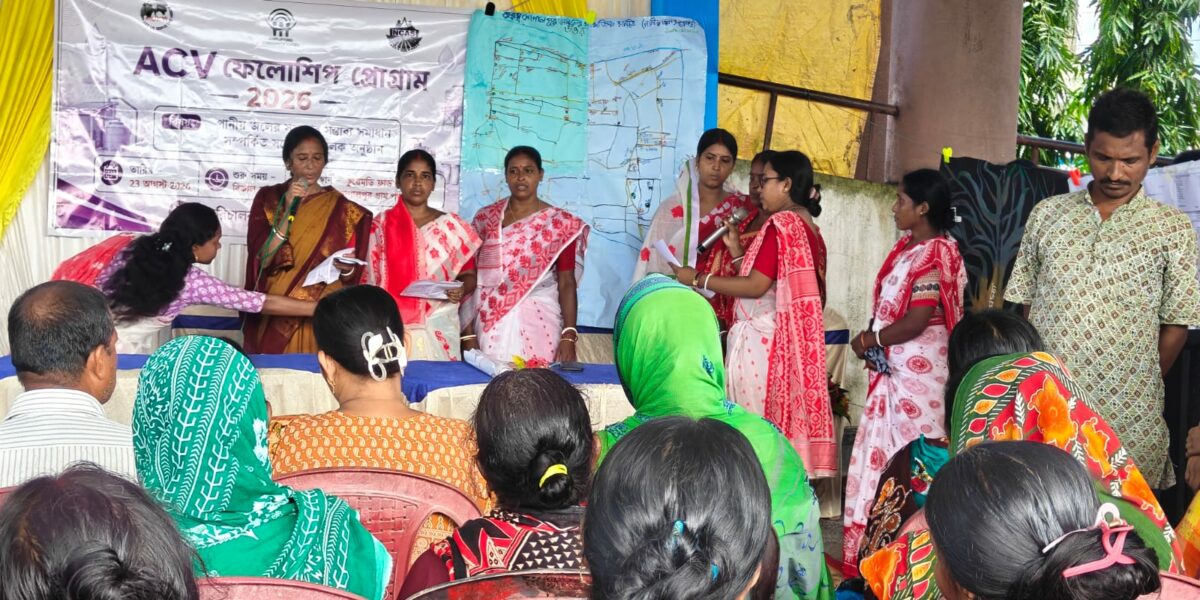
An awareness programme on groundwater scarcity and access to safe drinking water was organised at the Kuyemuri Flood Centre under the ACV (Amplifying Community Voices) Project, in collaboration with NCAS (National Centre for Advocacy Studies). Nearly 150 community members and stakeholders from Kuyemuri and Surendranagar villages under Heramba Gopalpur Gram Panchayat participated in the programme and shared their experiences, concerns and suggestions related to the growing water crisis in the area.
Ahead of the programme, a small data collection exercise was carried out to understand the availability of safe drinking water sources, the condition of local tubewells, and the duration and extent of water scarcity experienced by households. These findings were presented during the programme and became an important basis for discussion with community members and other stakeholders.
A water resource mapping exercise was also undertaken to identify existing water sources and understand their present condition, accessibility and patterns of use. Community members actively contributed by sharing first-hand experiences of collecting water, the seasonal challenges they face and the difficulties encountered when commonly used water sources become inadequate or inaccessible.
The discussion also explored practical ways to reduce pressure on available water resources. Participants spoke about promoting mixed cultivation, selecting crops and seeds that require comparatively less water, and encouraging water-efficient agricultural practices. Everyday water-use practices were also discussed, including the need to reduce avoidable wastage while collecting water from tubewells. Community members observed that narrow-necked bottles often lead to significant spillage, particularly when water flows rapidly, and highlighted the importance of using more suitable containers and collection methods.
Fellows and representatives from organisations including DRCSC, ISWS, BTS and others also joined the programme and shared suggestions based on their field experience, enriching the discussion around possible local responses to groundwater stress.
One of the important outcomes of the programme was the shared understanding that addressing water scarcity requires more than one-time awareness. Regular community-level data collection, documentation and dialogue are essential to understand how the situation is changing and to build stronger evidence for appropriate solutions.
It was collectively decided that the concerns, findings and suggestions emerging from the programme would be taken forward through an appropriate local forum, enabling community members to place their proposals before relevant stakeholders and seek measures to improve access to safe drinking water and address groundwater scarcity.
Through the ACV Project, MUKTI continues to create spaces where community voices, local evidence and collective action come together, helping people participate more meaningfully in identifying and advocating for solutions to the challenges that directly affect their lives.
Project Activities
- A village for independent and enterprising women (A VIEW) (5)
- About Mukti (11)
- Accreditation (14)
- AGM (63)
- Agriculture Reforms (130)
- Ambulance Service (2)
- Amplifying Community Voices (77)
- Awards (17)
- Awareness and Empowerment (141)
- Awareness drives (64)
- Bio-Village-Kankandighi (10)
- Careers (10)
- Chick Rearing Programme for Marginalised Women (17)
- CHILD (25)
- Climate Resilience River Embankment (46)
- Covid-19 (74)
- Cultural Shows (7)
- Cyclone Aila (13)
- Cyclone Amphan (44)
- Cyclone Bulbul (30)
- Cyclone Dana (3)
- Cyclone Remal (12)
- Cyclone Response & Recovery (90)
- Cyclone Tolerant Houses (15)
- Cyclone Yaas (57)
- Daily Activities USA (25)
- Disaster Recovery (265)
- Editorial (73)
- Editorial by Abir Biswas (1)
- Editorial by Amit Kumar Dey (4)
- Editorial by Ananya Chatterjee (3)
- Editorial by Ankita Kothiyal (5)
- Editorial by Chandrachur Chatterjee (1)
- Editorial by Debabrata Halder (2)
- Editorial by Dr. Alokananda Ghosh Sengupta (2)
- Editorial by Kasturi Bakshi (1)
- Editorial by Monami Mitra (1)
- Editorial by Nandita (4)
- Editorial by Pampa Karmakar (1)
- Editorial by Paramita Panja (1)
- Editorial by Pranay Patra (1)
- Editorial by Prof. Pradeep Ray (1)
- Editorial by Ranitendranath Tagore (2)
- Editorial by Sankar Halder (16)
- Editorial by Satyajit Ray (11)
- Editorial by Sohini Mehta (1)
- Editorial by Sonamon Basu (3)
- Editorial by Soumitra Bose (4)
- Editorial by Subhankar Basu (1)
- Editorial by Supriya Sarkar (1)
- Editorial by Supriyo Banerjee (4)
- Editorial by Ujjwal Maity (2)
- Education and Enrichment (470)
- Environment and Resilience (132)
- Featured Activities (32)
- Gram Clinic (9)
- Health Water & Sanitation (103)
- HOPE (10)
- Impact Stories List (109)
- Integrated Development (247)
- International Management Institute (IMI) (2)
- Jal hi Kal (6)
- KF Mukti Clinic (2)
- Kitchen Gardening (16)
- Livelihood & Enablement (241)
- MCDF (122)
- Medical Camp (48)
- MIT (8)
- MKSS (61)
- MSS (161)
- Mukti Academia (5)
- Mukti Academy (2)
- Mukti BSI Digital Herberium (1)
- Mukti Craft (18)
- Mukti Cultural (2)
- Mukti Employment Exchange (MEE) (29)
- Mukti Fresh (15)
- Mukti Gram - Egra (12)
- Mukti Gram - Purbashridharpur (172)
- Mukti Green Defense in Sundarbans (12)
- Mukti URBAN (18)
- Mukti USA (2)
- Mukti Yoga (12)
- Mukto Dhara (2)
- Navya (3)
- NIRMAN (5)
- Northumbria University (2)
- Obituary (6)
- Observance Days Celebration (54)
- Organic Farming & Training Support (49)
- Pond Rejuvenation (21)
- Prerana (5)
- Projects For Mukti Wide (7)
- Queen Mary University of London (1)
- Rights and Special Needs (132)
- Run for Cause (16)
- Run4SafeFood (11)
- SDF (6)
- Shahoshini (15)
- Skill & Enterprise Development (21)
- Smart lab (5)
- Social Stock Exchange (2)
- Social Workers' Convention (1)
- Sundarbans Green (SUN-G) (15)
- Sunderban development fair project (4)
- Suraksha Songlap (3)
- Surya (28)
- Sustainable Agriculture Movement (67)
- SWAS-2-0 (23)
- Swastha Shongini (33)
- Swavalamban Accelerator in Sundarbans (SWAS) (22)
- Tour for Cause (52)
- TSS (222)
- UDAAN (9)
- Uncategorized (109)
- University of Calcutta (2)
- Value Education (12)
- Valued Partners (3)
- Vocational Trainings (15)
- VOICE (15)
- Voice Sunderban (2)