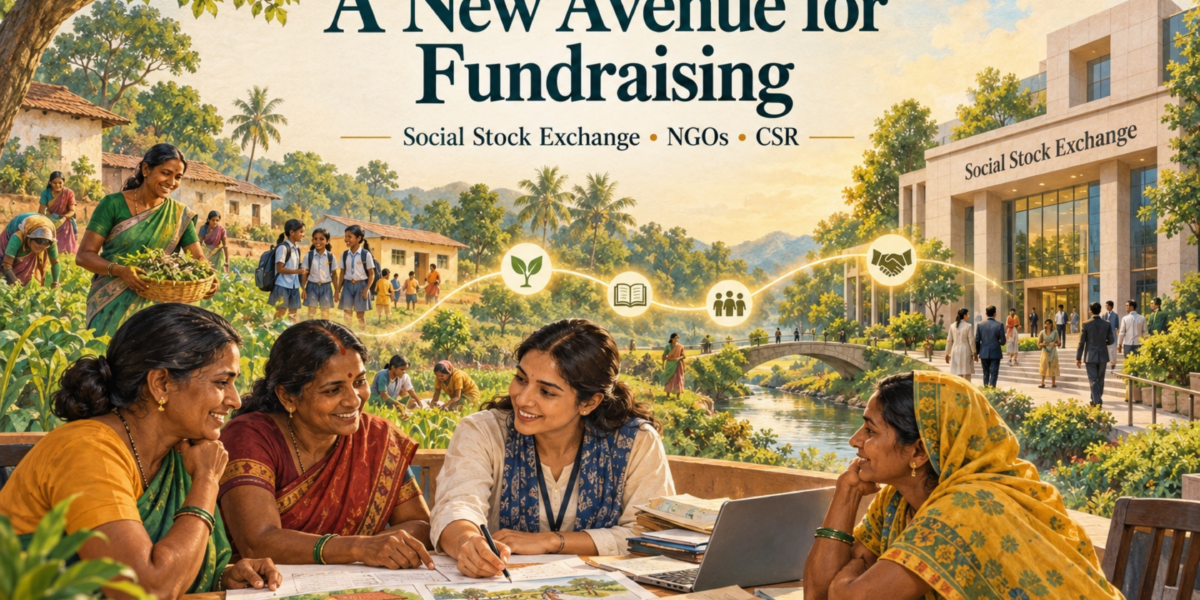
A New Avenue for Fundraising: What the Social Stock Exchange offers NGOs
For those of us working in the development sector, funding decisions have a very human meaning. They influence whether a woman can build a dependable livelihood, whether a child receives continued educational support, and whether a vulnerable family can move towards greater security. Any new avenue for financing social development must ultimately be understood through these possibilities.
The recent changes permitting Corporate Social Responsibility (CSR) expenditure through the Social Stock Exchange (SSE) offer one such opportunity. Through notifications dated 27 May 2026, the Ministry of Corporate Affairs introduced a framework enabling companies to subscribe to eligible Zero Coupon Zero Principal (ZCZP) instruments as part of their CSR expenditure. A corresponding amendment to Schedule VII of the Companies Act, 2013 expressly recognises this route.
For MUKTI, this development connects with an existing journey. We are already registered with the NSE Social Stock Exchange and have raised funds through a listed ZCZP issue for our SWAS 2.0 programme. That mobilisation took place outside the CSR route. The amendment now opens an additional avenue for corporate partners to support eligible ZCZP issues through their CSR funds.
A ZCZP instrument pays no interest and does not require repayment of the principal contribution. It enables eligible not-for-profit organisations registered with the SSE to raise funds for social projects through a regulated framework. Contributors participate without expecting a financial return, while organisations undertake the prescribed disclosures and reporting.
Under the new provisions, expenditure through this route cannot exceed 10% of a company’s total CSR expenditure for the financial year. A company spending ₹10 crore on CSR during a year, for example, may deploy up to ₹1 crore through eligible ZCZP subscriptions.
The framework also defines responsibilities for the issuing organisation. Rule 4A limits project duration to no more than three succeeding financial years from the issue of the instrument. Upon termination of the instrument’s listing, any unspent amount must be transferred to a fund included in Schedule VII, and a compliance report submitted to SEBI.
Subscribing companies are exempt from undertaking impact assessment for projects funded through these instruments. The issuing organisation must continue the disclosures and impact reporting required under the SSE framework. This keeps fund utilisation, project progress and outcomes central to the process.
There are encouraging signs of institutional interest. On 9 June 2026, NSE announced its decision to earmark 10% of its annual CSR corpus for projects listed on its Social Stock Exchange. This is a publicly stated commitment; the announcement does not provide recipient-wise details of completed subscriptions.
Yet a policy opening can serve communities only when organisations and contributors understand how to use it. Awareness at both the NGO level and the corporate CSR level is essential.
NGOs need accessible guidance on eligibility, registration, fundraising documents, project budgets and continuing reporting obligations. They also need to understand the distinction between registering with the SSE and successfully raising funds through a ZCZP issue. Smaller grassroots organisations would benefit from practical workshops, mentoring and support to strengthen their financial and programme documentation.
Corporate CSR teams need equal attention. Awareness efforts should explain how the subscription route works, its expenditure ceiling, the approvals and documentation involved, and the information available to assess an organisation and its proposed project. Joint sessions involving NGOs, corporate teams, stock exchanges and sector bodies could help turn regulatory awareness into informed participation.
From a programme development perspective, our responsibility begins with listening to communities. A project must reflect their priorities and explain how the proposed activities will lead to meaningful change. In a women’s livelihood programme, this means looking beyond training numbers to examine whether women can apply their skills, access markets and develop more dependable incomes.
At MUKTI, our existing SSE experience provides a foundation for exploring this additional funding avenue. It also reinforces the importance of preparing credible projects, maintaining reliable records and communicating progress honestly.
The Social Stock Exchange offers an opportunity to bring community aspirations before a wider network of supporters. Realising that opportunity will require awareness, organisational readiness and committed partnerships. Its success should be visible in the lives of the people whose hopes give every project its purpose.
Ankita Kothiyal
Director (Program)
Project Activities
- A village for independent and enterprising women (A VIEW) (5)
- About Mukti (11)
- Accreditation (14)
- AGM (63)
- Agriculture Reforms (130)
- Ambulance Service (2)
- Amplifying Community Voices (78)
- Awards (17)
- Awareness and Empowerment (141)
- Awareness drives (64)
- Bio-Village-Kankandighi (10)
- Careers (10)
- Chick Rearing Programme for Marginalised Women (17)
- CHILD (25)
- Climate Resilience River Embankment (46)
- Covid-19 (74)
- Cultural Shows (7)
- Cyclone Aila (13)
- Cyclone Amphan (44)
- Cyclone Bulbul (30)
- Cyclone Dana (3)
- Cyclone Remal (12)
- Cyclone Response & Recovery (90)
- Cyclone Tolerant Houses (15)
- Cyclone Yaas (57)
- Daily Activities USA (25)
- Disaster Recovery (265)
- Editorial (74)
- Editorial by Abir Biswas (1)
- Editorial by Amit Kumar Dey (4)
- Editorial by Ananya Chatterjee (3)
- Editorial by Ankita Kothiyal (6)
- Editorial by Chandrachur Chatterjee (1)
- Editorial by Debabrata Halder (2)
- Editorial by Dr. Alokananda Ghosh Sengupta (2)
- Editorial by Kasturi Bakshi (1)
- Editorial by Monami Mitra (1)
- Editorial by Nandita (4)
- Editorial by Pampa Karmakar (1)
- Editorial by Paramita Panja (1)
- Editorial by Pranay Patra (1)
- Editorial by Prof. Pradeep Ray (1)
- Editorial by Ranitendranath Tagore (2)
- Editorial by Sankar Halder (16)
- Editorial by Satyajit Ray (11)
- Editorial by Sohini Mehta (1)
- Editorial by Sonamon Basu (3)
- Editorial by Soumitra Bose (4)
- Editorial by Subhankar Basu (1)
- Editorial by Supriya Sarkar (1)
- Editorial by Supriyo Banerjee (4)
- Editorial by Ujjwal Maity (2)
- Education and Enrichment (472)
- Environment and Resilience (132)
- Featured Activities (32)
- Gram Clinic (9)
- Health Water & Sanitation (103)
- HOPE (10)
- Impact Stories List (109)
- Integrated Development (248)
- International Management Institute (IMI) (2)
- Jal hi Kal (6)
- KF Mukti Clinic (2)
- Kitchen Gardening (16)
- Livelihood & Enablement (242)
- MCDF (122)
- Medical Camp (48)
- MIT (8)
- MKSS (63)
- MSS (161)
- Mukti Academia (5)
- Mukti Academy (2)
- Mukti BSI Digital Herberium (1)
- Mukti Craft (18)
- Mukti Cultural (2)
- Mukti Employment Exchange (MEE) (29)
- Mukti Fresh (15)
- Mukti Gram - Egra (12)
- Mukti Gram - Purbashridharpur (172)
- Mukti Green Defense in Sundarbans (12)
- Mukti URBAN (19)
- Mukti USA (2)
- Mukti Yoga (12)
- Mukto Dhara (2)
- Navya (3)
- NIRMAN (5)
- Northumbria University (2)
- Obituary (6)
- Observance Days Celebration (54)
- Organic Farming & Training Support (49)
- Pond Rejuvenation (21)
- Prerana (5)
- Projects For Mukti Wide (7)
- Queen Mary University of London (1)
- Rights and Special Needs (134)
- Run for Cause (16)
- Run4SafeFood (11)
- SDF (6)
- Shahoshini (16)
- Skill & Enterprise Development (21)
- Smart lab (5)
- Social Stock Exchange (2)
- Social Workers' Convention (1)
- Sundarbans Green (SUN-G) (15)
- Sunderban development fair project (4)
- Suraksha Songlap (3)
- Surya (29)
- Sustainable Agriculture Movement (67)
- SWAS-2-0 (23)
- Swastha Shongini (33)
- Swavalamban Accelerator in Sundarbans (SWAS) (22)
- Tour for Cause (52)
- TSS (222)
- UDAAN (9)
- Uncategorized (109)
- University of Calcutta (2)
- Value Education (13)
- Valued Partners (3)
- Vocational Trainings (15)
- VOICE (15)
- Voice Sunderban (2)