MUKTI Contributes to the United Nations’ Beyond GDP Global Consultation
Kolkata | August 2026
MUKTI has formally submitted its policy recommendations to the United Nations Intergovernmental Process on Beyond GDP, contributing to a global effort to redefine how nations measure progress and sustainable development beyond traditional economic indicators.
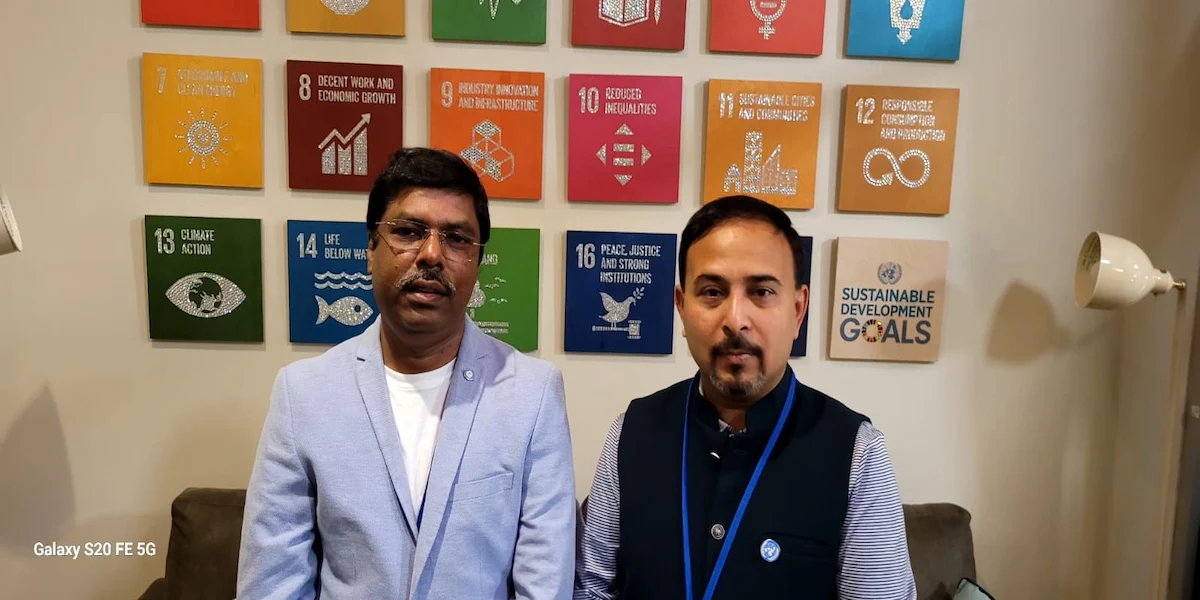
The submission follows MUKTI’s participation in the high-level panel discussion “Beyond GDP: Moving from Analysis to Impact”, held at the Goals Lounge, United Nations Headquarters, New York, on 13 July 2026 during the High-level Political Forum (HLPF) on Sustainable Development.
Representing MUKTI, Sankar Halder, Founder & President, and Satyajit Roy, Secretary, joined policymakers, UN officials, researchers, civil society organizations, and delegates from around the world to discuss the future of measuring human progress. Following the session, the Government of Spain, as Co-Facilitator of the UN intergovernmental process, invited stakeholders worldwide to submit recommendations for an Elements Paper, which will serve as an important input to future UN discussions on the Beyond GDP framework.
Drawing upon more than 22 years of grassroots experience in the Indian Sundarbans, MUKTI submitted a comprehensive policy paper based on its integrated approach to sustainable development. The submission reflects practical experience across multiple Sustainable Development Goals (SDGs), including climate-resilient agriculture, mangrove restoration, women’s institutions and self-help groups, community health, education, renewable energy, sustainable livelihoods, disaster resilience, environmental conservation, and community-led development.
The central message of MUKTI’s submission is that development should not be measured solely by the wealth a nation creates, but also by the well-being of its people and the sustainability of its natural ecosystems. The paper advocates for a Beyond GDP framework that recognizes climate justice, values the contributions of communities affected by climate-induced migration, and acknowledges that frontline communities are not merely vulnerable populations but also knowledge producers, innovators, and custodians of globally significant ecosystems. It recommends that future development measurement incorporate indicators for community well-being, ecosystem stewardship, sustainable use of natural resources, community knowledge capital, climate resilience, and responsible global supply chains, ensuring that progress reflects both human prosperity and planetary health.
Building on its practical experience in the Sundarbans, MUKTI also proposed several innovative concepts for international consideration, including Community Knowledge Capital, Climate Stewardship and Resilience, Sustainable Resource Efficiency, and recognition of the environmental services provided by communities conserving globally significant ecosystems. The submission further highlights the importance of measuring natural resource use responsibly, accounting for environmental impacts across global supply chains, and ensuring that development pathways remain equitable, inclusive, and environmentally sustainable.
The paper emphasizes that communities living on the frontlines of climate change—such as those in the Sundarbans—contribute very little to global greenhouse gas emissions, yet experience some of the greatest impacts of climate change. At the same time, they protect one of the world’s largest mangrove ecosystems, providing invaluable services through carbon sequestration, biodiversity conservation, and protection against cyclones and storm surges. MUKTI therefore called for greater recognition of climate justice and stronger international support for such communities as partners in achieving global sustainability.
MUKTI believes that the Beyond GDP initiative represents a historic opportunity to reshape development thinking by placing people, nature, resilience, and future generations at the heart of public policy. The organization is grateful to the United Nations and the co-facilitators of the process for providing civil society organizations with an opportunity to contribute grassroots perspectives to this important global dialogue.
As a development organization working at the community level for more than two decades, MUKTI remains committed to sharing practical experience, supporting evidence-based policymaking, and collaborating with governments, international organizations, academic institutions, and communities worldwide to build a more inclusive, equitable, and sustainable future where progress is measured not only by economic growth but also by the well-being of people and the health of the planet.
Project Activities
- A village for independent and enterprising women (A VIEW) (5)
- About Mukti (11)
- Accreditation (14)
- AGM (63)
- Agriculture Reforms (130)
- Ambulance Service (2)
- Amplifying Community Voices (77)
- Awards (17)
- Awareness and Empowerment (141)
- Awareness drives (64)
- Bio-Village-Kankandighi (10)
- Careers (10)
- Chick Rearing Programme for Marginalised Women (17)
- CHILD (25)
- Climate Resilience River Embankment (46)
- Covid-19 (74)
- Cultural Shows (7)
- Cyclone Aila (13)
- Cyclone Amphan (44)
- Cyclone Bulbul (30)
- Cyclone Dana (3)
- Cyclone Remal (12)
- Cyclone Response & Recovery (90)
- Cyclone Tolerant Houses (15)
- Cyclone Yaas (57)
- Daily Activities USA (25)
- Disaster Recovery (265)
- Editorial (73)
- Editorial by Abir Biswas (1)
- Editorial by Amit Kumar Dey (4)
- Editorial by Ananya Chatterjee (3)
- Editorial by Ankita Kothiyal (5)
- Editorial by Chandrachur Chatterjee (1)
- Editorial by Debabrata Halder (2)
- Editorial by Dr. Alokananda Ghosh Sengupta (2)
- Editorial by Kasturi Bakshi (1)
- Editorial by Monami Mitra (1)
- Editorial by Nandita (4)
- Editorial by Pampa Karmakar (1)
- Editorial by Paramita Panja (1)
- Editorial by Pranay Patra (1)
- Editorial by Prof. Pradeep Ray (1)
- Editorial by Ranitendranath Tagore (2)
- Editorial by Sankar Halder (16)
- Editorial by Satyajit Ray (11)
- Editorial by Sohini Mehta (1)
- Editorial by Sonamon Basu (3)
- Editorial by Soumitra Bose (4)
- Editorial by Subhankar Basu (1)
- Editorial by Supriya Sarkar (1)
- Editorial by Supriyo Banerjee (4)
- Editorial by Ujjwal Maity (2)
- Education and Enrichment (470)
- Environment and Resilience (132)
- Featured Activities (32)
- Gram Clinic (9)
- Health Water & Sanitation (103)
- HOPE (10)
- Impact Stories List (109)
- Integrated Development (247)
- International Management Institute (IMI) (2)
- Jal hi Kal (6)
- KF Mukti Clinic (2)
- Kitchen Gardening (16)
- Livelihood & Enablement (241)
- MCDF (122)
- Medical Camp (48)
- MIT (8)
- MKSS (61)
- MSS (161)
- Mukti Academia (5)
- Mukti Academy (2)
- Mukti BSI Digital Herberium (1)
- Mukti Craft (18)
- Mukti Cultural (2)
- Mukti Employment Exchange (MEE) (29)
- Mukti Fresh (15)
- Mukti Gram - Egra (12)
- Mukti Gram - Purbashridharpur (172)
- Mukti Green Defense in Sundarbans (12)
- Mukti URBAN (18)
- Mukti USA (2)
- Mukti Yoga (12)
- Mukto Dhara (2)
- Navya (3)
- NIRMAN (5)
- Northumbria University (2)
- Obituary (6)
- Observance Days Celebration (54)
- Organic Farming & Training Support (49)
- Pond Rejuvenation (21)
- Prerana (5)
- Projects For Mukti Wide (7)
- Queen Mary University of London (1)
- Rights and Special Needs (132)
- Run for Cause (16)
- Run4SafeFood (11)
- SDF (6)
- Shahoshini (15)
- Skill & Enterprise Development (21)
- Smart lab (5)
- Social Stock Exchange (2)
- Social Workers' Convention (1)
- Sundarbans Green (SUN-G) (15)
- Sunderban development fair project (4)
- Suraksha Songlap (3)
- Surya (28)
- Sustainable Agriculture Movement (67)
- SWAS-2-0 (23)
- Swastha Shongini (33)
- Swavalamban Accelerator in Sundarbans (SWAS) (22)
- Tour for Cause (52)
- TSS (222)
- UDAAN (9)
- Uncategorized (109)
- University of Calcutta (2)
- Value Education (12)
- Valued Partners (3)
- Vocational Trainings (15)
- VOICE (15)
- Voice Sunderban (2)