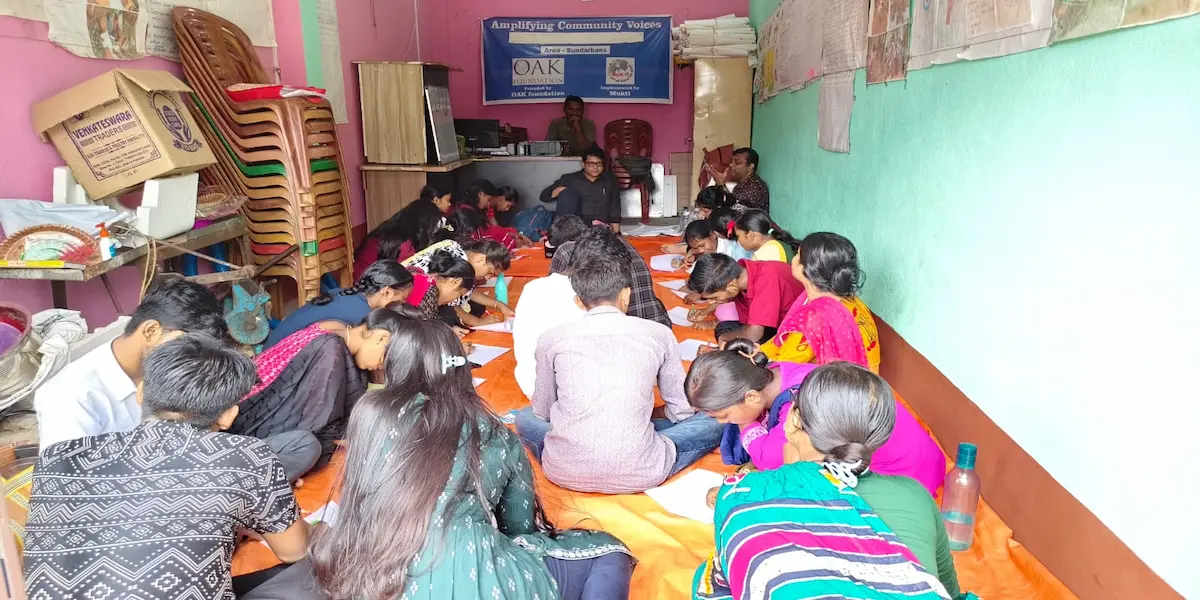
Environmental Awareness Workshop Explores the Vision of a Sustainable Model Village
Kuyemuri, 19 July 2026: Mukti organised an Environmental Awareness Workshop at the Kuyemuri Mukti Office, bringing together 27 participants for an interactive learning session on environmental conservation, climate awareness, and the vision of building a sustainable model village.
The workshop adopted a participatory approach, encouraging participants to reflect on the transformation of their villages over time and to explore practical solutions for creating environmentally sustainable communities.
The session began with an introduction, followed by a guided reflection exercise in which participants imagined what their village had looked like nearly 200 years ago. They then compared it with the present-day village, discussing changes in roads, housing, transportation, culture, climate, electricity, social media, cooking practices, schools, healthcare, timekeeping, and food habits. This exercise helped participants understand how development has improved many aspects of daily life while also creating new environmental challenges.
Building on this discussion, participants identified the positive and negative environmental changes that have taken place over the years and reflected on how these changes have influenced both nature and community life.
The workshop also covered fundamental concepts such as the meaning of the environment, climate, and weather, along with the living and non-living components of the environment. Participants learned about the relationship between the environment, weather, seasons, and climate through practical examples, making these concepts easier to understand.
Special emphasis was placed on environmental pollution in the Sundarbans. Through locally relevant examples, participants discussed different forms of pollution affecting the region and examined their impact on biodiversity, natural resources, and community livelihoods. The session also explored healthy and sustainable food choices, highlighting that dietary practices often depend on individual health conditions, local availability, and regional contexts rather than being universally good or bad.
An engaging activity using the RGB colour-coding method further helped participants understand environmental concepts in a simple and interactive manner.
One of the key highlights of the workshop was the discussion on what constitutes an Ideal Village and the steps required to develop a Sustainable Model Village in the Sundarbans. Participants explored practical measures such as environmental conservation, responsible use of natural resources, sustainable agriculture, community participation, and eco-friendly practices that can contribute to building resilient villages.
To encourage creative thinking and practical application, each participant was assigned the task of designing their own Model Village Plan, which they will present during the next online meeting. This exercise aims to promote innovative ideas while strengthening participants’ understanding of sustainable rural development.
The workshop concluded with active participation and meaningful discussions, reinforcing the importance of environmental awareness, collective responsibility, and community-led action in creating sustainable and climate-resilient villages across the Sundarbans.
Project Activities
- A village for independent and enterprising women (A VIEW) (5)
- About Mukti (11)
- Accreditation (14)
- AGM (63)
- Agriculture Reforms (127)
- Ambulance Service (2)
- Amplifying Community Voices (76)
- Awards (17)
- Awareness and Empowerment (139)
- Awareness drives (62)
- Bio-Village-Kankandighi (10)
- Careers (10)
- Chick Rearing Programme for Marginalised Women (16)
- CHILD (25)
- Climate Resilience River Embankment (46)
- Covid-19 (74)
- Cultural Shows (7)
- Cyclone Aila (13)
- Cyclone Amphan (44)
- Cyclone Bulbul (30)
- Cyclone Dana (3)
- Cyclone Remal (12)
- Cyclone Response & Recovery (90)
- Cyclone Tolerant Houses (15)
- Cyclone Yaas (57)
- Daily Activities USA (25)
- Disaster Recovery (265)
- Editorial (73)
- Editorial by Abir Biswas (1)
- Editorial by Amit Kumar Dey (4)
- Editorial by Ananya Chatterjee (3)
- Editorial by Ankita Kothiyal (5)
- Editorial by Chandrachur Chatterjee (1)
- Editorial by Debabrata Halder (2)
- Editorial by Dr. Alokananda Ghosh Sengupta (2)
- Editorial by Kasturi Bakshi (1)
- Editorial by Monami Mitra (1)
- Editorial by Nandita (4)
- Editorial by Pampa Karmakar (1)
- Editorial by Paramita Panja (1)
- Editorial by Pranay Patra (1)
- Editorial by Prof. Pradeep Ray (1)
- Editorial by Ranitendranath Tagore (2)
- Editorial by Sankar Halder (16)
- Editorial by Satyajit Ray (11)
- Editorial by Sohini Mehta (1)
- Editorial by Sonamon Basu (3)
- Editorial by Soumitra Bose (4)
- Editorial by Subhankar Basu (1)
- Editorial by Supriya Sarkar (1)
- Editorial by Supriyo Banerjee (4)
- Editorial by Ujjwal Maity (2)
- Education and Enrichment (464)
- Environment and Resilience (132)
- Featured Activities (32)
- Gram Clinic (9)
- Health Water & Sanitation (102)
- HOPE (10)
- Impact Stories List (109)
- Integrated Development (240)
- International Management Institute (IMI) (2)
- Jal hi Kal (6)
- KF Mukti Clinic (2)
- Kitchen Gardening (16)
- Livelihood & Enablement (239)
- MCDF (122)
- Medical Camp (47)
- MIT (8)
- MKSS (59)
- MSS (158)
- Mukti Academia (5)
- Mukti Academy (2)
- Mukti BSI Digital Herberium (1)
- Mukti Craft (18)
- Mukti Cultural (2)
- Mukti Employment Exchange (MEE) (29)
- Mukti Fresh (15)
- Mukti Gram - Egra (12)
- Mukti Gram - Purbashridharpur (172)
- Mukti Green Defense in Sundarbans (12)
- Mukti URBAN (14)
- Mukti USA (2)
- Mukti Yoga (12)
- Mukto Dhara (2)
- Navya (3)
- NIRMAN (4)
- Northumbria University (2)
- Obituary (6)
- Observance Days Celebration (54)
- Organic Farming & Training Support (46)
- Pond Rejuvenation (21)
- Prerana (5)
- Projects For Mukti Wide (7)
- Queen Mary University of London (1)
- Rights and Special Needs (131)
- Run for Cause (15)
- Run4SafeFood (10)
- SDF (6)
- Shahoshini (15)
- Skill & Enterprise Development (21)
- Smart lab (5)
- Social Stock Exchange (2)
- Social Workers' Convention (1)
- Sundarbans Green (SUN-G) (15)
- Sunderban development fair project (4)
- Suraksha Songlap (1)
- Surya (27)
- Sustainable Agriculture Movement (64)
- SWAS-2-0 (23)
- Swastha Shongini (33)
- Swavalamban Accelerator in Sundarbans (SWAS) (22)
- Tour for Cause (52)
- TSS (221)
- UDAAN (9)
- Uncategorized (110)
- University of Calcutta (2)
- Value Education (12)
- Valued Partners (3)
- Vocational Trainings (15)
- VOICE (15)
- Voice Sunderban (2)