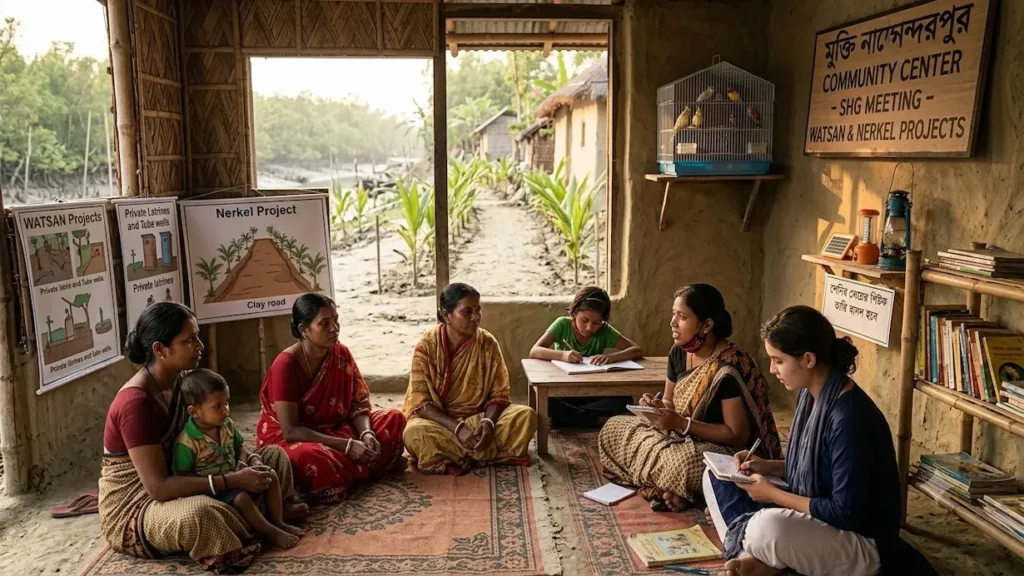

In the second half of 2021, I had just begun my first semester of pursuing a Master’s in Social Work at St. Xavier’s University, Kolkata. Like students across the country, my classes were being conducted online as the world continued to grapple with the COVID-19 pandemic. As part of our curriculum, we were required to undertake a concurrent fieldwork internship. Being my very first internship, I looked at it simply as an academic requirement, an opportunity to gain some practical exposure alongside my online classes. I had no idea that it would completely change the way I understood social work.
I imagined spending my internship writing reports, collecting data, and proofreading documents. It sounded straightforward enough. What I didn’t expect was that every report would introduce me to a new story, stories of children determined to continue learning despite overwhelming odds, parents who believed education was the greatest gift they could offer their children, and teachers who refused to let a generation of students fall behind.
Until then, education had always been something I assumed would always be there.
Like most students, I worried about examinations, assignments, and grades. I had never paused to think about what it meant to want an education but be unable to attend an online class because there was no smartphone at home. I had never imagined siblings taking turns to use a single mobile phone, unreliable internet connections disrupting lessons, or children gradually drifting away from school because learning had simply become inaccessible.
As I spent weeks reading project reports, speaking with team members, and learning about Mukti’s education initiatives, I realised these weren’t isolated incidents. They reflected the everyday reality of countless children across the Sundarbans, a region renowned for its breathtaking mangrove forests, yet marked by geographical isolation, recurring cyclones, fragile livelihoods, and limited access to opportunities. The pandemic only widened the educational divide. For many families already struggling to rebuild their lives after Cyclone Amphan, COVID-19 became another challenge that threatened their children’s future.
What impressed me most was that Mukti wasn’t simply focused on educating children; it was focused on ensuring that the pandemic didn’t take away their right to learn.
The Talented Students Sponsorship (TSS) programme was one of the first initiatives that truly stayed with me. Reading about students who had excelled academically yet stood on the verge of abandoning their dreams because of financial hardship was deeply moving. Through the generosity of sponsors, these students were able to pursue higher education in medicine, engineering, nursing, science, and other fields. It reminded me that talent is everywhere, but opportunity is not—and sometimes, all it takes is one person willing to believe in another.
I found the same philosophy reflected in the Mukti Support School (MSS) programme. Rather than replacing formal education, it strengthened it. Even during one of the most challenging periods for education, children continued to receive academic support, individual attention, and encouragement to keep learning. The programme wasn’t just helping students improve academically; it was helping them remain connected to education at a time when many were at risk of dropping out altogether.
The Mukti Kishalaya Support School (MKSS) offered another perspective. It highlighted the importance of building strong foundations during the earliest years of learning, even amidst unprecedented disruption. Bright classrooms, engaging activities, and dedicated teachers created an environment where children could continue to learn with confidence and curiosity despite the uncertainty surrounding them.
Somewhere along the way, I realised I had stopped looking at these projects as reports.
Each document represented a family making sacrifices so that a child could continue studying during one of the most difficult periods in recent history. Each statistic represented a student refusing to give up. Each classroom represented a community determined that a global pandemic would not define the future of its children.
The internship quietly changed the way I looked at development work. Real change rarely happens overnight. It unfolds gradually, in a child reconnecting with learning after months away from school, in a teacher finding new ways to reach students during a pandemic, and in a sponsor choosing to invest in the future of someone they may never meet.
These are not the stories that usually make headlines. They don’t announce themselves with grand achievements or dramatic moments. Instead, they unfold quietly, one classroom, one teacher, one student at a time. And perhaps those are the stories that deserve to be told the most.
Related Blog
Spotlight
Background of Sundarbans and Birth of Mukti Sundarbans is a mangrove forest area at the delta of Ganga…

Oct 21, 2021
Just as the meaning of her name, ‘MUKTI’ specifies redemption or salvation in Hindi, and she has decided…
Oct 08, 2021

Back in June 2020, as I was working from home, one day I had a wild idea. I…
Sep 30, 2021
Dec 12, 2021